
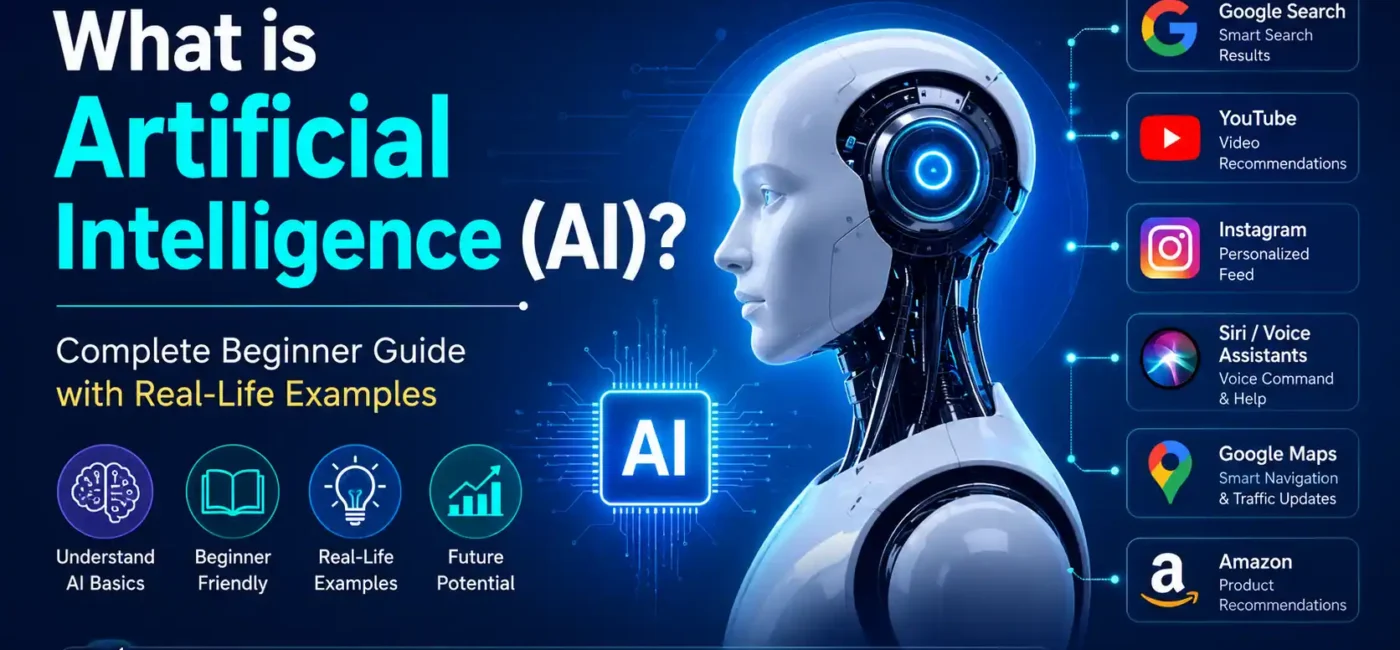
Artificial Intelligence (AI) has become one of the most powerful and fast-evolving technologies shaping the modern digital economy, completely transforming the way people search, learn, communicate, and make decisions online. Today, AI is no longer a futuristic concept or limited to advanced research laboratories; instead, it is deeply integrated into everyday digital platforms that billions of people use regularly. Whether it is Google Search ranking billions of web pages in seconds, YouTube recommending videos based on user behavior, or Instagram and TikTok personalizing feeds with high accuracy, AI is continuously working in the background to deliver more relevant, faster, and highly personalized digital experiences that feel almost intuitive.
The real power of Artificial Intelligence comes from its ability to process massive volumes of data in real time, detect hidden patterns, and generate highly accurate predictions without requiring constant human input. This capability has completely changed how businesses operate and compete in the digital world. Companies now rely on AI for customer support automation, advanced fraud detection systems, marketing campaign optimization, predictive analytics, and intelligent decision-making. At the same time, individuals interact with AI daily through voice assistants, smart navigation tools, recommendation engines, and personalized search results that make digital interactions smoother and more efficient.
In today’s AI-driven era, understanding Artificial Intelligence is no longer optional—it has become essential for students, marketers, entrepreneurs, content creators, and business owners. This is because AI directly influences SEO performance, online visibility, content ranking systems, and digital marketing strategies. Every online interaction such as clicks, watch time, search queries, and engagement signals is analyzed by AI systems to continuously improve user experience and refine content delivery. As we move further into 2026 and beyond, AI will continue to redefine how digital ecosystems function and how success is achieved online.
What is Artificial Intelligence (AI)?
Artificial Intelligence (AI) refers to the ability of machines, computers, or software systems to perform tasks that normally require human intelligence, such as learning, reasoning, problem-solving, understanding language, and recognizing patterns. In simple SEO terms, AI is a technology that enables digital systems to think, learn, and improve automatically based on data.
AI systems work by processing large volumes of structured and unstructured data and converting that data into actionable insights. These systems do not “think” like humans in a biological sense, but they simulate intelligent behavior using algorithms and mathematical models. This makes AI extremely powerful for search engines, recommendation systems, and automated decision-making tools.
In modern SEO ecosystems, Artificial Intelligence plays a critical role in ranking websites, analyzing user intent, detecting spam, and improving search relevance. Google’s AI-driven algorithms, for example, continuously evaluate content quality, keyword relevance, engagement signals, and user satisfaction metrics to determine search rankings.
How Artificial Intelligence Works: Machine Learning and Deep Learning Explained
Artificial Intelligence works through a combination of advanced technologies, primarily Machine Learning (ML) and Deep Learning (DL), which allow systems to learn from data and improve over time without being explicitly programmed for every task.
Machine Learning is a subset of AI where algorithms are trained on large datasets to identify patterns and make predictions. For example, an AI system can analyze millions of search queries to understand what users are looking for and then improve search results accordingly. This is one of the core technologies behind SEO ranking systems used by Google and Bing.
Deep Learning takes AI a step further by using artificial neural networks inspired by the human brain. These networks process complex data such as images, speech, and natural language. Deep Learning is widely used in facial recognition, voice assistants like Siri and Alexa, and AI content generation tools.
In SEO and digital marketing, AI models analyze user behavior signals such as click-through rate (CTR), bounce rate, dwell time, and engagement patterns. These signals help search engines understand content quality and relevance, making AI a key factor in modern ranking systems.
Types of Artificial Intelligence in Modern Technology
Artificial Intelligence is categorized into different types based on capability and functionality, each playing a different role in digital systems and SEO algorithms.
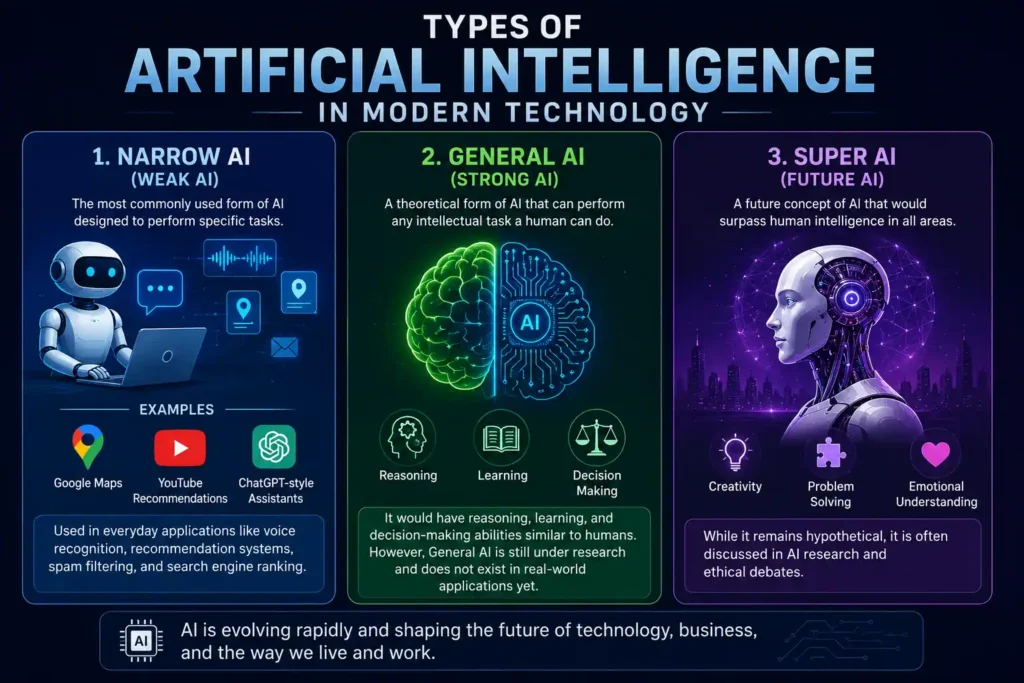
Narrow AI (Weak AI) is the most commonly used form of Artificial Intelligence today. It is designed to perform specific tasks such as voice recognition, recommendation systems, spam filtering, and search engine ranking. Examples include Google Maps, YouTube recommendations, and ChatGPT-style assistants.
General AI (Strong AI) refers to a theoretical form of AI that can perform any intellectual task a human can do. It would have reasoning, learning, and decision-making abilities similar to humans. However, General AI is still under research and does not exist in real-world applications yet.
Super AI is a future concept of Artificial Intelligence that would surpass human intelligence in all areas, including creativity, problem-solving, and emotional understanding. While it remains hypothetical, it is often discussed in AI research and ethical debates.
Real-Life Examples of Artificial Intelligence (AI Applications)
Artificial Intelligence is already integrated into almost every digital platform we use daily, often without users even realizing it.
One of the most common examples is AI in search engines like Google. Google uses AI-powered algorithms such as RankBrain and BERT to understand search intent and deliver the most relevant results. These systems analyze billions of queries to improve SEO ranking accuracy and user satisfaction.
Social media platforms like Instagram, TikTok, and Facebook also use AI to personalize content feeds. These platforms track user behavior, engagement patterns, and viewing history to recommend posts and videos that are most likely to keep users engaged.
AI is also widely used in smartphones for features like face recognition, predictive text, voice assistants, and camera optimization. Mobile AI systems learn user behavior over time and adapt to provide a more personalized experience.
In e-commerce platforms such as Amazon, AI is used for product recommendations, dynamic pricing, and customer behavior analysis, which directly impacts sales and conversion rates.
Applications of Artificial Intelligence in Key Industries
Artificial Intelligence is transforming multiple industries by improving efficiency, reducing costs, and enhancing decision-making processes. It is becoming a core technology for digital transformation across healthcare, education, business, finance, and marketing.
In healthcare, AI is used for medical image analysis, disease prediction, drug discovery, and patient monitoring systems. AI-powered tools can detect diseases like cancer at an early stage, improving survival rates and treatment outcomes. Hospitals are also using AI for robotic-assisted surgeries, virtual health assistants, and predictive analytics to manage patient data more effectively. Examples of AI tools in healthcare include IBM Watson Health, Google DeepMind Health, and Aidoc, which help doctors make faster and more accurate clinical decisions.
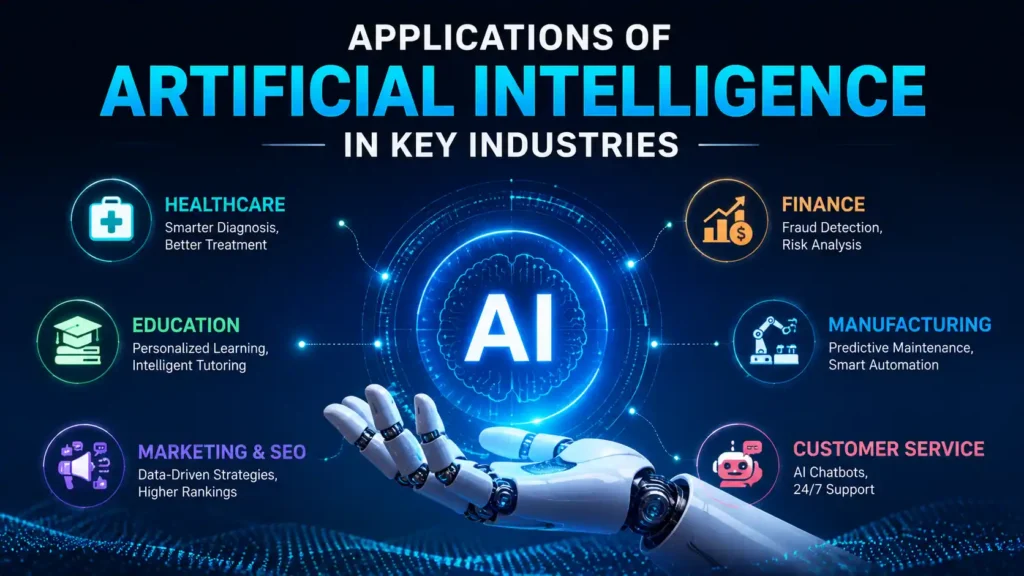
In education, AI is revolutionizing learning experiences through personalized learning platforms, intelligent tutoring systems, and automated grading systems. Students can now learn at their own pace with AI-based educational tools that adapt to their learning style. AI also helps teachers by reducing administrative workload and providing real-time insights into student performance. Popular tools include Squirrel AI, Khanmigo by Khan Academy, and Duolingo AI features, which make learning more interactive and accessible globally.
In digital marketing and SEO, AI is used for keyword analysis, content optimization, competitor research, and audience targeting. AI tools help marketers create data-driven strategies that improve website ranking and organic traffic. It also supports content generation, A/B testing, and predictive SEO analysis to understand what users are likely to search next. Common AI tools in this field include Surfer SEO, Semrush AI, Jasper AI, and Ahrefs AI features.
Beyond these industries, AI is also widely used in finance for fraud detection and risk analysis, in manufacturing for predictive maintenance, and in customer service through AI chatbots that provide 24/7 support. This shows that AI is not limited to one field but is a universal technology shaping the future of work and innovation across the world.
Benefits of Artificial Intelligence in SEO and Digital Growth
Artificial Intelligence provides significant benefits that directly improve SEO performance, online visibility, and digital growth.
AI improves automation by handling repetitive tasks such as keyword research, data analysis, content optimization, competitor analysis, and performance reporting. This allows marketers and businesses to focus more on strategic planning, creative content development, and long-term growth.
AI also enhances decision-making by analyzing large datasets and identifying search trends, audience behavior, and ranking opportunities that humans may miss. This helps businesses create more accurate marketing strategies and improve their search engine performance.
Another major benefit of AI is personalization. AI systems deliver highly personalized content experiences based on user preferences, search intent, and browsing behavior. This increases user engagement, retention, and conversion rates.
Popular AI tools such as Surfer SEO, Semrush AI, and Jasper AI can help businesses improve keyword research, optimize content, generate SEO-friendly copy, and track digital marketing performance more effectively.
Challenges and Risks of Artificial Intelligence
Despite its advantages, Artificial Intelligence also presents certain challenges that must be carefully managed.
One major concern is data privacy, as AI systems collect and analyze large amounts of user information. If not handled properly, this can lead to security risks and privacy violations.
Another challenge is algorithmic bias, where AI systems may produce unfair or inaccurate results due to biased training data. This can negatively impact search rankings, hiring systems, and decision-making processes.
Job displacement is also a concern, as automation may replace certain repetitive tasks. However, AI also creates new job opportunities in data science, machine learning, and digital transformation sectors.
Future of Artificial Intelligence in SEO and Digital Technology
The future of Artificial Intelligence is expected to be highly advanced and deeply integrated into every digital system. AI will continue to improve search engine algorithms, making them more accurate in understanding user intent and content quality.
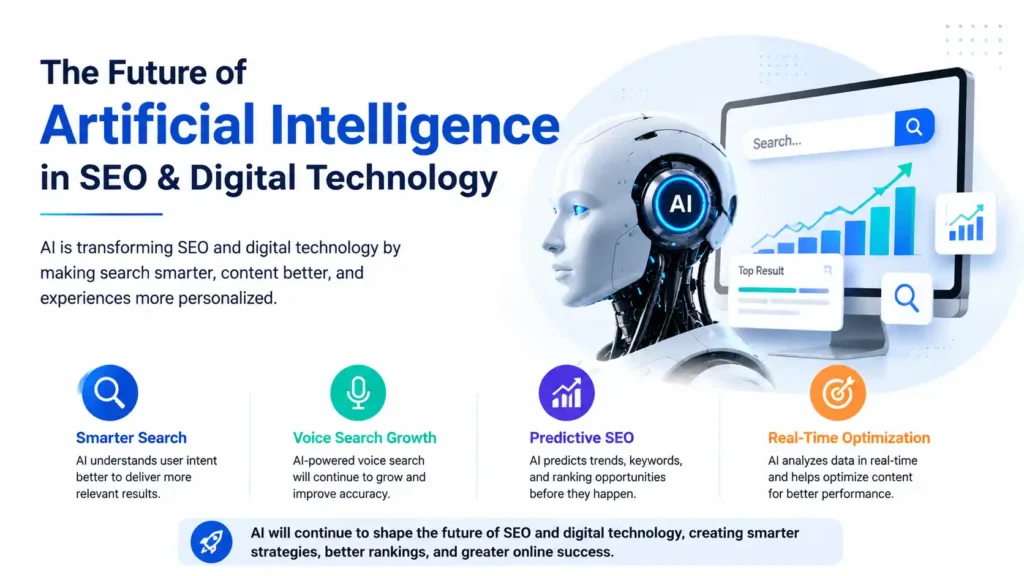
In SEO, AI will play an even greater role in predictive search, voice search optimization, and real-time content ranking. Websites that adapt to AI-driven SEO strategies will have a competitive advantage in organic search visibility.
Emerging technologies such as generative AI, autonomous systems, and AI-powered analytics will further transform industries, making digital ecosystems more intelligent and efficient.
FAQs
1. What is Artificial Intelligence (AI) in simple and SEO-friendly terms?
Artificial Intelligence (AI) is a modern digital technology that allows computers, machines, and software systems to perform human-like tasks such as learning, problem-solving, decision-making, and language understanding. In SEO terms, AI is the backbone of search engine algorithms, content ranking systems, and user behavior analysis used by platforms like Google, YouTube, and Bing.
2. How does Artificial Intelligence (AI) work in Google Search and SEO ranking?
Artificial Intelligence in Google Search works by analyzing billions of web pages using machine learning algorithms like RankBrain, BERT, and neural matching systems. These AI systems understand search intent, keyword relevance, content quality, and user engagement signals to rank websites. In SEO, AI helps determine which pages appear on top of Google search results based on relevance and authority.
3. What are the best real-life examples of Artificial Intelligence (AI) usage?
The most common real-life examples of Artificial Intelligence include Google Search, YouTube recommendation system, Instagram and TikTok algorithms, voice assistants like Siri and Alexa, and navigation apps like Google Maps. AI is also used in online shopping platforms like Amazon for product recommendations and personalized user experience.
4. How is Artificial Intelligence used in digital marketing and SEO strategies?
Artificial Intelligence is widely used in digital marketing and SEO for keyword research, content optimization, competitor analysis, search intent mapping, and audience targeting. AI tools help marketers identify trending keywords, optimize blog content, improve click-through rates (CTR), and increase organic traffic from search engines like Google.
5. Can Artificial Intelligence improve website ranking on Google?
Yes, Artificial Intelligence can significantly improve website ranking by helping create SEO-optimized content, improving user engagement signals, enhancing keyword targeting, and optimizing page structure. AI-powered SEO tools analyze Google ranking factors and suggest improvements to increase visibility in search engine results pages (SERPs).
6. What are the main types of Artificial Intelligence used today?
The main types of Artificial Intelligence include Narrow AI (used in search engines and apps), General AI (theoretical human-like intelligence), and Super AI (future advanced intelligence). Currently, Narrow AI is widely used in SEO, content recommendation systems, and digital automation platforms.
7. Is Artificial Intelligence replacing SEO experts and digital marketers?
Artificial Intelligence is not replacing SEO experts but is instead enhancing their performance. AI automates repetitive tasks like keyword research and data analysis, while SEO professionals focus on strategy, content creation, and optimization. Human creativity is still essential for successful SEO campaigns.
8. What is the role of Artificial Intelligence in content creation and blogging?
Artificial Intelligence helps in content creation by generating blog ideas, optimizing SEO keywords, improving readability, and analyzing competitor content. AI-powered writing tools assist bloggers in creating high-quality, search-engine-friendly content that ranks better on Google and attracts organic traffic.
9. How is Artificial Intelligence changing the future of SEO and Google algorithms?
Artificial Intelligence is making SEO more advanced by improving search intent understanding, voice search optimization, and personalized search results. Google’s AI algorithms now focus more on user experience, content relevance, and engagement metrics rather than just keyword matching.
10. What are the benefits of Artificial Intelligence for beginners and businesses?
Artificial Intelligence benefits beginners and businesses by automating tasks, improving productivity, enhancing decision-making, and increasing online visibility. In SEO, AI helps businesses rank higher on Google, attract more organic traffic, and improve digital marketing performance efficiently.