
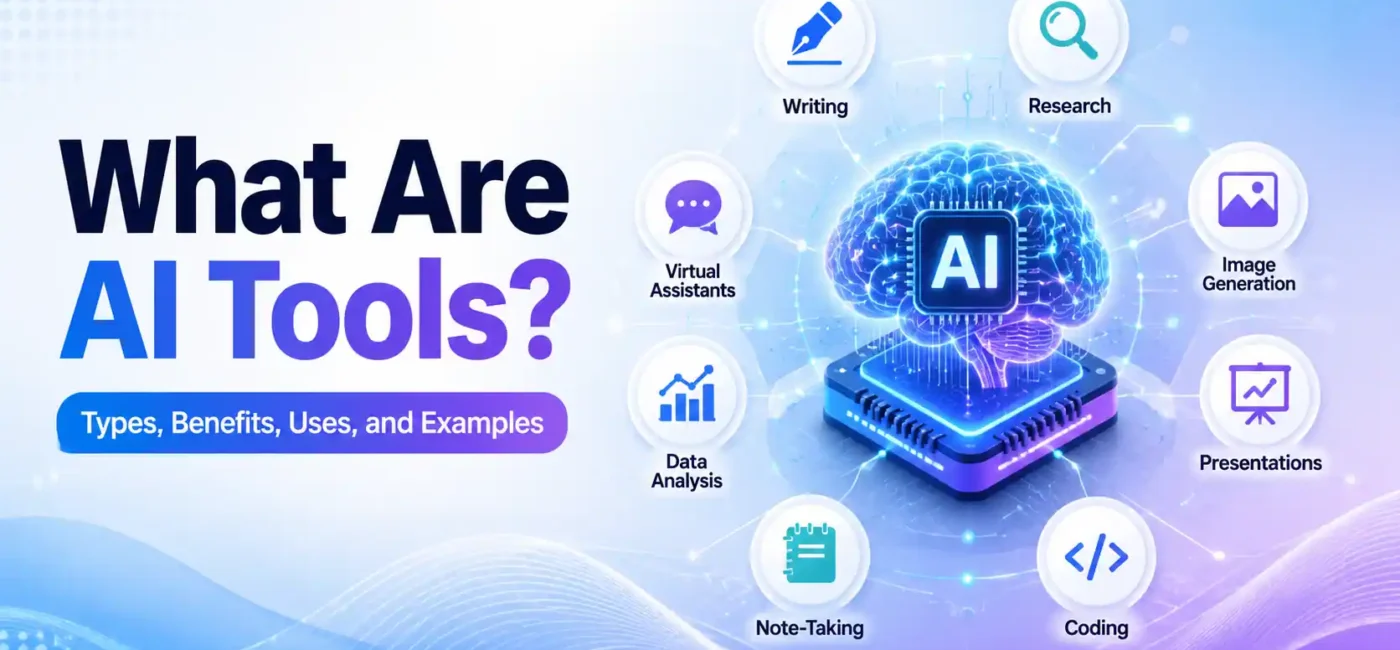
AI tools are software applications that use artificial intelligence techniques to analyse information, recognise patterns, automate tasks, and support problem-solving or decision-making. Unlike traditional software that mainly follows fixed instructions, many AI tools can process large amounts of data, learn from patterns, and generate useful responses based on user input. These tools are now used across fields such as education, business, healthcare, engineering, marketing, research, and digital communication.
The growing popularity of AI tools is linked to their ability to save time, reduce repetitive work, organise information, and support users in completing complex activities. Students may use them for research and learning, while businesses can apply them to customer service, data analysis, content creation, and workplace automation. However, AI-generated results are not always accurate and should be reviewed carefully. This article explains how AI tools work, their common types, popular uses, key benefits, practical examples, and the importance of using them responsibly.
How Do AI Tools Work?
AI tools work by using computer-based systems to process information, recognise patterns, and generate outputs in response to specific instructions. Unlike traditional software, which follows a fixed set of rules, many AI tools can learn from data and improve their performance over time. Their operation is usually based on artificial intelligence techniques such as machine learning, natural language processing, computer vision, and deep learning. The specific technology used depends on the tool’s purpose. For example, an AI writing assistant may use natural language processing, while an image-recognition system may rely on computer vision.
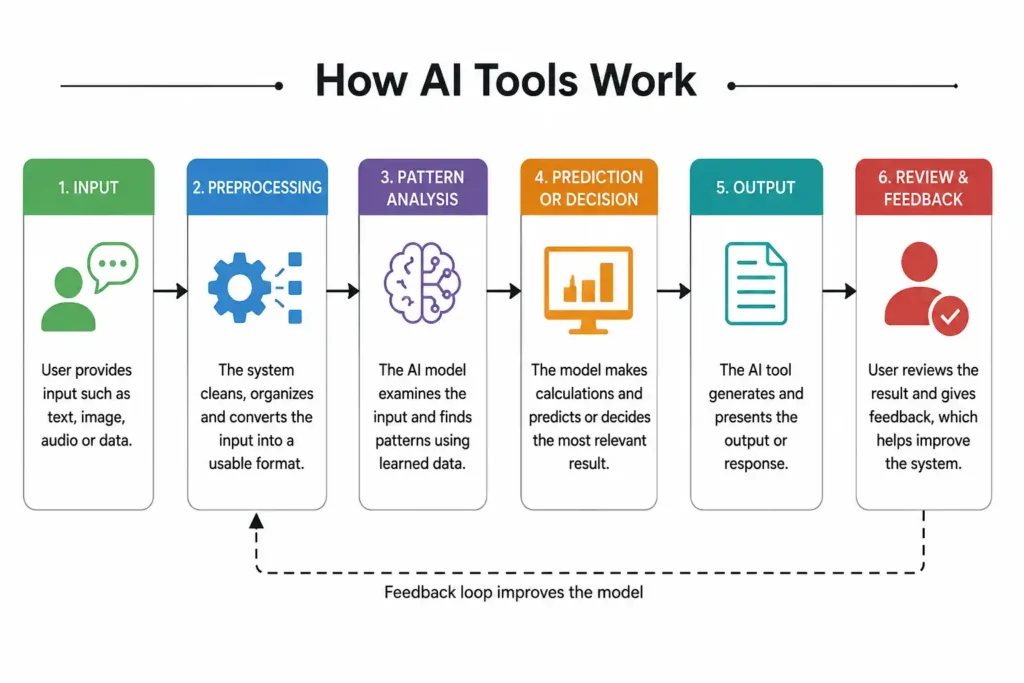
The workflow of an AI tool typically begins with data collection. AI systems require large amounts of relevant data to learn how to perform a task. This data may include written text, images, audio recordings, numerical information, or user interactions. Before the data is used, it is often cleaned and organised to remove errors, repeated information, or irrelevant content. The quality of the data is important because inaccurate, limited, or biased data can affect the reliability of the tool’s results.
After the data has been prepared, an AI model is trained by using algorithms. During training, the system analyses the data to identify relationships, trends, and recurring patterns. For instance, a language-based AI tool may examine how words and sentences are commonly structured, whereas a recommendation system may study users’ previous choices to predict what they may prefer in the future. The model makes predictions during this process, compares them with expected results, and adjusts its internal calculations to reduce errors. This process may be repeated many times until the system achieves an acceptable level of accuracy.
Once trained, the AI model can respond to new information that was not included in its original training examples. When a user enters a question, uploads an image, or provides a command, the tool processes the input and compares it with the patterns it has learned. It then produces the most suitable output based on probability and the instructions it has received. For example, an AI chatbot predicts an appropriate sequence of words to create a response, while an AI image generator interprets a written description and creates visual content that matches it.
Some AI tools also continue learning through user feedback and additional data. Feedback can help developers identify errors, improve accuracy, and make the system more useful. However, AI tools do not think, understand, or make judgments in the same way as human beings. Their responses are based on mathematical calculations, learned patterns, and available data. As a result, they may produce inaccurate information, reflect bias, or misunderstand the user’s intention.
Therefore, the output of AI tools should be reviewed carefully, particularly when used for university assignments, professional decisions, medical information, or legal matters. Students should verify AI-generated information through reliable academic sources and follow their institution’s policies on artificial intelligence. When used responsibly, AI tools can support learning, research, communication, data analysis, and problem-solving, but they should assist rather than replace human knowledge and critical thinking.
Common Types of AI Tools
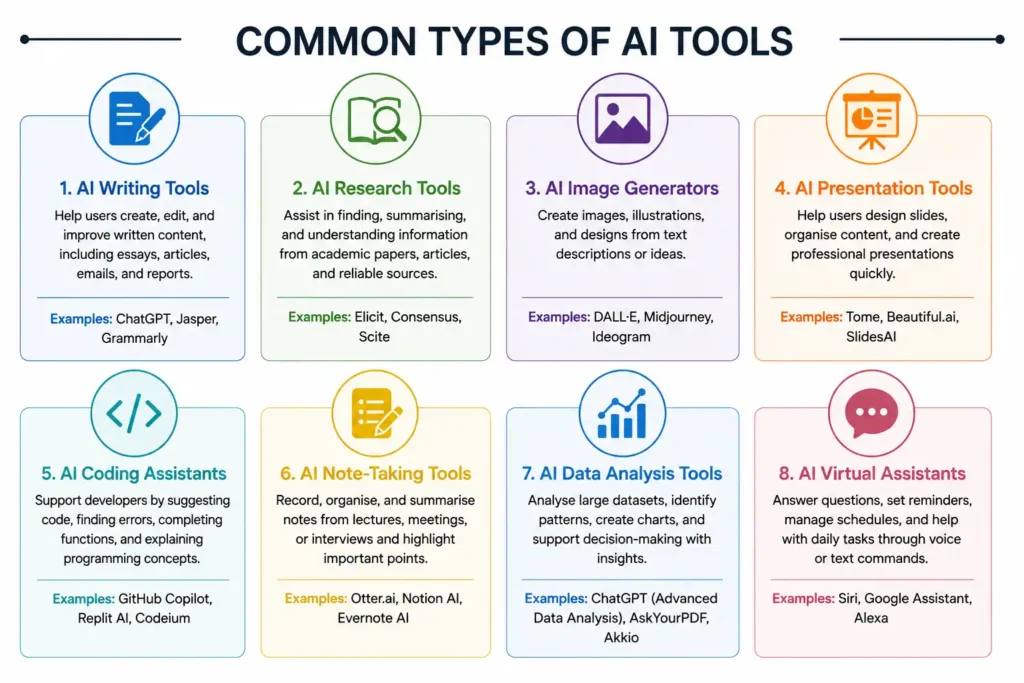
AI tools are available in many forms, and each type is designed to support a particular task. Some tools help users create written content, while others assist with research, design, coding, presentations, data analysis, and daily organisation. Understanding the main categories of AI tools can help users choose the most suitable option for their academic, professional, or personal needs.
AI Writing Tools
AI writing tools help users create, edit, and improve written content. They can generate ideas, suggest headings, correct grammar, rewrite sentences, and improve readability. Students may use these tools to understand how to structure essays or improve their language, while businesses may use them for emails, product descriptions, reports, and marketing content. Popular examples include ChatGPT, which can assist with brainstorming and drafting; Jasper, which is commonly used for marketing content; and Grammarly, which helps users improve grammar, clarity, and writing style. However, users should review the final text carefully to ensure accuracy and originality.
AI Research Tools
AI research tools are designed to help users find, organise, and understand information. They can summarise long articles, identify key points, suggest related topics, and help locate academic sources. These tools are especially useful for university students and researchers who need to review large amounts of information. Examples include Elicit, which helps users search for and summarise academic research; Consensus, which supports evidence-based searches across research papers; and Scite, which helps users examine how academic studies have been cited. AI-generated summaries should always be checked against the original source.
AI Image Generators
AI image generators create visual content from written instructions. A user can describe an object, scene, character, or design, and the tool produces an image based on that description. These tools are commonly used in graphic design, advertising, education, social media, and content creation. Examples include DALL·E, Midjourney, and Ideogram, all of which can generate images from text-based prompts. They can save time and support creativity, but users should also consider copyright, originality, ownership, and ethical concerns when using generated images.
AI Presentation Tools
AI presentation tools assist users in creating slides, layouts, and visual content. They can suggest slide structures, shorten text, generate headings, and organise information into a professional format. Students can use them for university presentations, while businesses may use them for reports, meetings, and project proposals. Examples include Tome, which can generate presentation structures and visual narratives; Beautiful.ai, which supports automatic slide design and formatting; and SlidesAI, which can convert written content into presentation slides. The final presentation should still be reviewed to ensure that the information is clear, accurate, and suitable for the intended audience.
AI Coding Assistants
AI coding assistants support programmers by suggesting code, explaining errors, completing functions, and helping with debugging. They can be useful for both beginners and experienced developers. Students may use these tools to understand programming concepts, while professionals may use them to speed up software development. Examples include GitHub Copilot, which provides code suggestions within development environments; Replit AI, which supports coding, explanation, and debugging; and Codeium, which offers code completion and programming assistance. Generated code should be tested carefully because it may contain errors, security weaknesses, or unsuitable solutions.
AI Note-Taking Tools
AI note-taking tools help users record, organise, and summarise information. They can convert speech into text, identify important points from meetings, and create short summaries. These tools are useful for lectures, interviews, online classes, and workplace meetings. Examples include Otter.ai, which provides transcription and meeting summaries; Notion AI, which helps organise, rewrite, and summarise notes; and Evernote AI, which assists users in searching, managing, and improving their notes. These tools can save time and allow users to focus on the discussion instead of recording every detail manually.
AI Data Analysis Tools
AI data analysis tools examine large datasets and identify patterns, trends, or relationships. They can create charts, support forecasting, detect unusual results, and help users interpret information. These tools are widely used in business, healthcare, finance, education, and scientific research. Examples include ChatGPT with Advanced Data Analysis, which can help users examine datasets and create visualisations; AskYourPDF, which allows users to interact with and extract information from documents; and Akkio, which supports data analysis, forecasting, and predictive modelling. Human review remains important because poor-quality data or incorrect instructions can lead to misleading conclusions.
AI Virtual Assistants
AI virtual assistants help users complete everyday tasks through voice or text commands. They can answer questions, set reminders, manage schedules, provide directions, control smart devices, and support customer service. Common examples include Siri, Google Assistant, and Alexa. These assistants are widely used on smartphones, websites, speakers, and other smart devices. Although they can make daily tasks more convenient, users should consider privacy settings and the type of personal information shared with them.
Overall, different types of AI tools serve different purposes. Choosing the right tool depends on the user’s task, required level of accuracy, privacy needs, cost, ease of use, and ability to review the generated results. AI tools should be used as supportive resources rather than complete replacements for human knowledge, creativity, and decision-making.
Popular Uses of AI Tools
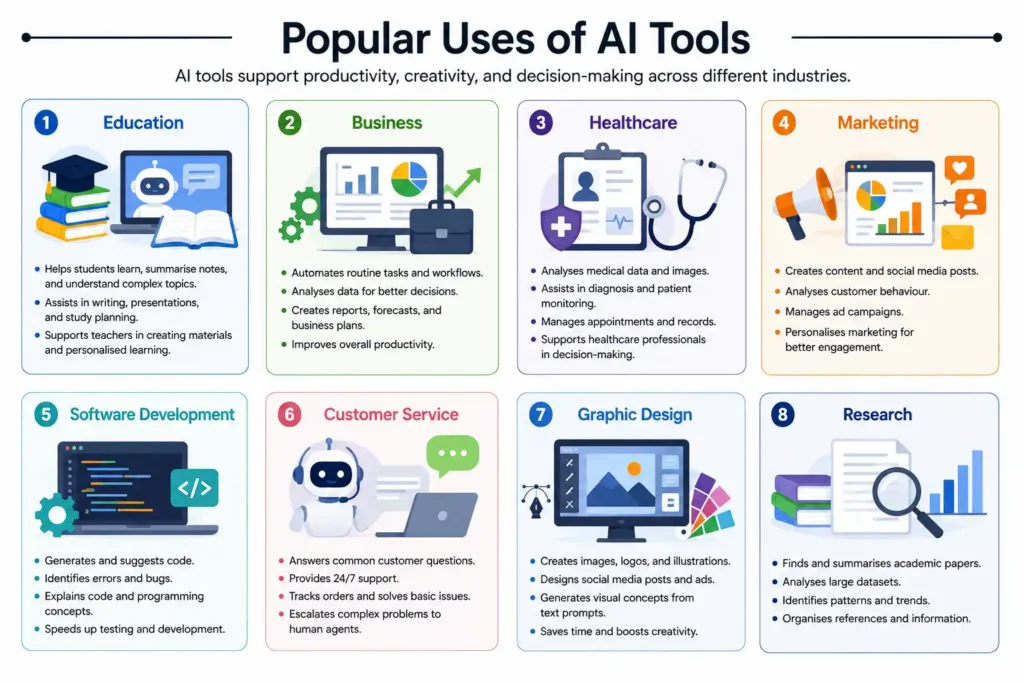
AI tools are used across many industries to improve efficiency, reduce manual work, and support better decision-making.
Education
In education, AI tools help students understand difficult topics, summarise notes, improve writing, prepare presentations, and organise study plans. Teachers may also use them to create learning materials and provide personalised support.
Business
Businesses use AI tools to automate routine tasks, analyse performance, prepare reports, manage schedules, and improve workplace productivity. They can also support financial planning and decision-making.
Healthcare
In healthcare, AI tools assist with medical data analysis, patient monitoring, appointment management, and disease detection. However, medical professionals must review AI-generated results before making important decisions.
Marketing
Marketing professionals use AI tools to create content, analyse customer behaviour, manage campaigns, conduct keyword research, and personalise advertisements for different audiences.
Software Development
Developers use AI coding tools to generate code, identify errors, explain programming concepts, and speed up software testing and development.
Customer Service
AI chatbots and virtual assistants can answer common questions, guide customers, track orders, and provide support at any time. Complex issues are usually transferred to human representatives.
Graphic Design
AI design tools help users create images, logos, social media posts, website graphics, and visual concepts from written instructions.
Research
Researchers use AI tools to find academic papers, summarise studies, organise references, analyse data, and identify patterns in large amounts of information.
Overall, AI tools are useful in many areas because they can save time and support complex tasks. However, human review remains necessary to ensure that the information is accurate, ethical, and appropriate.
Benefits of AI Tools
AI tools offer several practical benefits for students, professionals, researchers, and businesses. When used responsibly, they can reduce manual effort, improve efficiency, and support better decision-making.
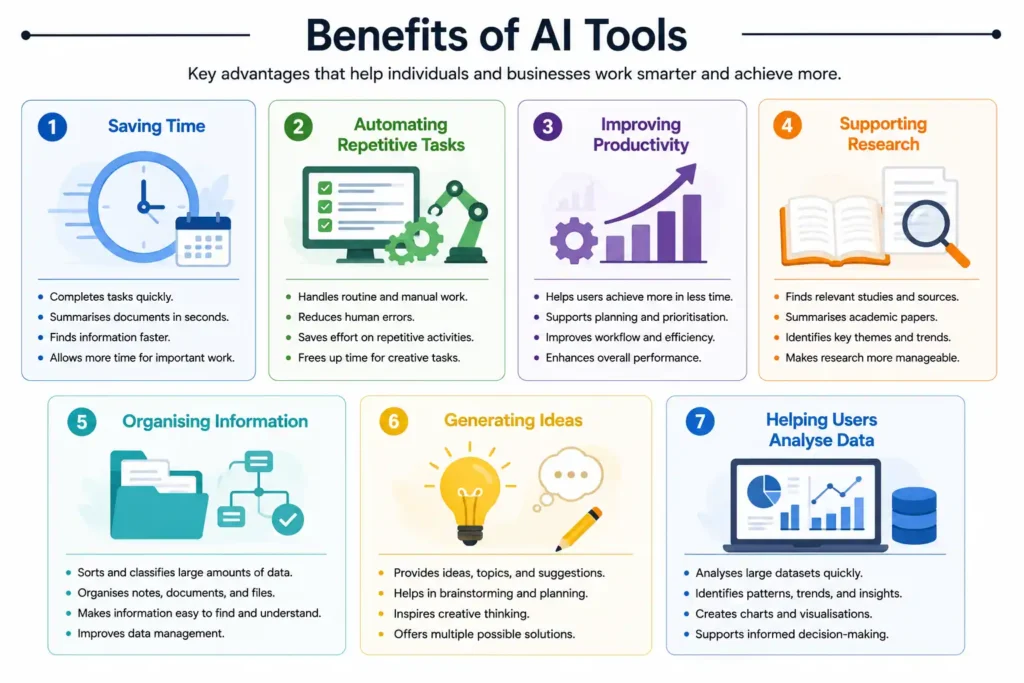
Saving Time
AI tools can complete many tasks more quickly than traditional methods. They can summarise documents, draft emails, search for information, create outlines, and process data within a short period. This allows users to spend more time on important or complex activities.
Automating Repetitive Tasks
Many routine tasks, such as organising files, entering data, scheduling appointments, answering common questions, and preparing basic reports, can be automated with AI. Automation reduces workload and allows users to focus on tasks that require human judgment and creativity.
Improving Productivity
AI tools can help users complete more work in less time. They support planning, writing, communication, project management, and task organisation. In workplaces, they may improve the speed and consistency of daily operations.
Supporting Research
Students and researchers can use AI tools to find relevant studies, summarise academic papers, identify key themes, and explore research questions. These tools can make the research process more manageable, although users must verify information through reliable original sources.
Organising Information
AI tools can sort, classify, and summarise large amounts of information. They can organise notes, documents, references, meeting records, and datasets, making important information easier to locate and understand.
Generating Ideas
AI can support brainstorming by suggesting topics, headings, questions, examples, designs, or possible solutions. This can be useful when users are unsure how to begin a project. However, the ideas should be reviewed and developed using human creativity and knowledge.
Analysing Data
AI tools can examine datasets, identify patterns, create charts, detect unusual results, and support forecasting. These capabilities help users understand complex information and make more informed decisions.
AI tools can save time, improve productivity, and support many academic and professional tasks. However, their outputs should always be reviewed for accuracy, relevance, privacy, and possible bias.
After understanding the meaning of AI tools, it is important to examine how they work. Most AI tools analyse information, identify patterns, and respond to instructions provided by users. Their capabilities vary depending on the technology, data, and purpose for which they were developed.
FAQs
Q1. What are AI tools used for?
AI tools are used to complete or support tasks that normally require human intelligence. They can assist with writing, research, image creation, data analysis, coding, customer service, presentations, and everyday organisation. Their purpose is generally to reduce manual effort and help users work more efficiently.
Q2. Are AI tools useful for students?
Yes, AI tools can support students with research, note-taking, brainstorming, grammar improvement, study planning, presentations, and understanding difficult topics. However, students should check all AI-generated information, use reliable academic sources, and follow their university’s rules on the use of artificial intelligence.
Q3. Are AI tools always accurate?
No, AI tools are not always accurate. They may produce incorrect information, misunderstand instructions, reflect bias, or generate references that do not exist. Users should review the output carefully and confirm important facts through trustworthy sources before using the information in academic or professional work.
Q4. Can AI tools replace human workers?
AI tools can automate certain repetitive and time-consuming tasks, but they cannot fully replace human creativity, judgment, communication, and ethical decision-making. In most situations, AI works best as a supporting tool that helps people perform their work more effectively.