
Software as a Service, better known as SaaS, has become one of the most powerful forces in the modern digital economy. Businesses no longer want slow, expensive, and difficult software systems that need heavy installation, manual updates, and large IT teams to manage. Instead, companies want cloud-based software, easy subscriptions, fast setup, automatic updates, remote access, and smooth integrations with other business tools. This is exactly why SaaS has grown from a simple software delivery model into a global business engine used by startups, small businesses, enterprises, freelancers, marketers, developers, schools, healthcare companies, finance teams, and online stores.
The biggest reason behind the rapid growth of SaaS is convenience. A business can start using a SaaS tool within minutes without buying servers or installing complex software on every computer. Whether someone is using a CRM platform, email marketing software, accounting tool, project management app, customer support system, AI writing tool, or e-commerce dashboard, they are already part of the SaaS ecosystem. This makes SaaS one of the most practical solutions for businesses that want to save time, reduce cost, improve productivity, and scale faster in a competitive digital market.
The SaaS industry is also growing because work itself has changed. Remote teams, hybrid offices, online businesses, digital payments, AI automation, cloud storage, and data-driven marketing all need flexible software. Old software models were like heavy machines fixed in one room, while SaaS works more like electricity: you turn it on, use what you need, and scale when demand increases. This simple but powerful model is the main reason SaaS continues to dominate the future of business technology.
Current SaaS Market Growth and Authentic Industry Data
The global SaaS market growth is not just a trend; it is backed by strong market data. Gartner forecasts worldwide public cloud end-user spending to reach $723.4 billion in 2025, and SaaS alone is expected to account for around $299.1 billion of that spending. Statista projects the worldwide Software as a Service market to reach $512.27 billion in revenue in 2026, with expected growth to $887.05 billion by 2030. Grand View Research also estimates that the SaaS market was worth $399.10 billion in 2024 and could reach around $819.23 billion by 2030, showing how strongly businesses are moving toward cloud software solutions.
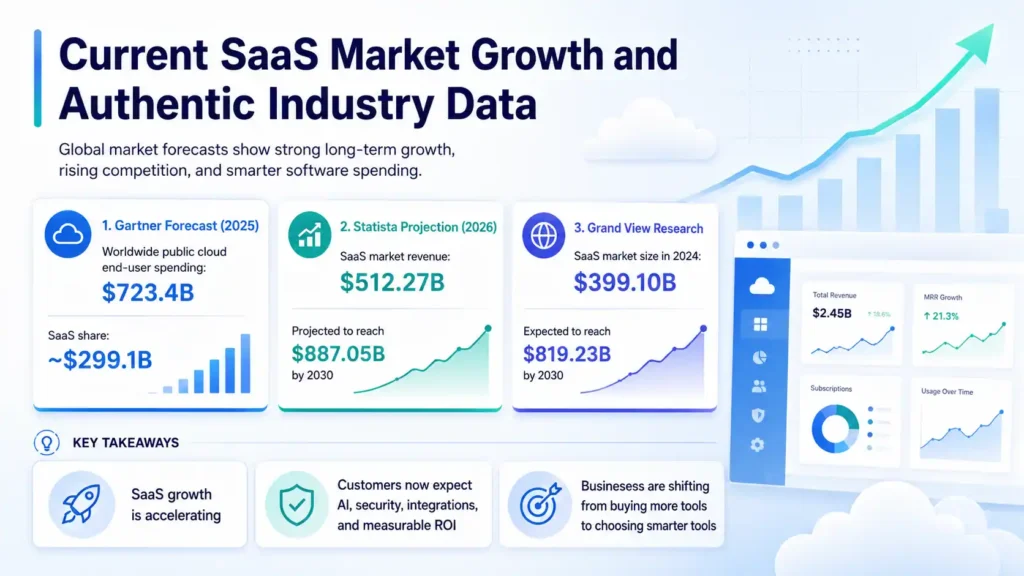
These numbers clearly show that SaaS is not slowing down. However, the market is becoming more mature and more competitive. In the early days, simply offering cloud-based software was enough to attract users. Today, customers want more than access. They want measurable value, automation, security, integrations, AI features, better pricing, and reliable customer support. This means the future of SaaS will not belong to every software company equally. It will belong to SaaS businesses that solve real problems and help customers save time, increase revenue, reduce manual work, and improve decision-making.
Another important point is that companies are now reviewing their software spending more carefully. BetterCloud’s SaaSOps research shows that organizations are becoming more focused on SaaS consolidation, cost control, and security. Many companies already use dozens or even hundreds of SaaS apps, but not every tool delivers equal value. This creates a new phase in SaaS growth where businesses are not just buying more tools; they are choosing smarter tools. The future of SaaS will be driven by quality, not just quantity.
Key SaaS Trends Shaping Future Growth
One of the biggest SaaS trends shaping the future is the rise of AI-powered SaaS platforms. Artificial intelligence is no longer a small bonus feature inside software. It is becoming the core of many SaaS products. AI SaaS tools can write content, summarize meetings, analyze customer behavior, automate workflows, generate reports, support customers, detect fraud, personalize marketing campaigns, and help teams make better decisions. This is why AI SaaS is becoming one of the fastest-growing parts of the software industry.
The beauty of AI in SaaS is that it turns software from a passive tool into an active assistant. Traditional SaaS waits for users to click buttons and enter data. AI-native SaaS can suggest actions, predict results, and automate repetitive tasks. For example, an AI CRM can identify hot leads, an AI email platform can recommend better subject lines, and an AI customer support tool can answer common questions without human delay. This makes SaaS more valuable because it not only stores information; it helps businesses act on that information faster.
Another major trend is vertical SaaS, which means SaaS software built for one specific industry. Instead of creating one general tool for everyone, vertical SaaS companies build software for healthcare, real estate, education, restaurants, fitness, construction, logistics, legal services, finance, and manufacturing. This trend is growing because different industries have different workflows. A clinic needs patient records and appointment scheduling, while a logistics company needs tracking, dispatching, and delivery management. Vertical SaaS wins because it feels more practical, more specific, and more useful for the customer’s daily work.
Usage-based pricing and hybrid SaaS pricing are also becoming important. Many SaaS companies used to charge only monthly or yearly subscription fees. Now, more platforms are mixing subscription pricing with usage-based charges. This means customers may pay a base plan plus extra costs based on API calls, AI credits, storage, seats, automation runs, or transactions. Maxio’s pricing research shows that hybrid pricing models are linked with strong SaaS growth, especially because they allow companies to charge according to actual value delivered. This is useful for both customers and SaaS providers because pricing becomes more flexible and scalable.
Security is another trend that cannot be ignored. As businesses store more data in SaaS applications, SaaS security, privacy, compliance, identity management, and access control are becoming essential. Companies want to know whether their SaaS providers protect customer data, offer encryption, support multi-factor authentication, provide audit logs, and follow compliance standards. A beautiful dashboard is not enough anymore. A SaaS company must build trust, because one data breach can damage customer confidence and brand reputation very quickly.
How AI Is Transforming the SaaS Industry
Artificial intelligence is changing the SaaS industry in a very deep way. Earlier, SaaS tools helped businesses manage tasks, but AI SaaS helps businesses complete tasks faster. This difference is huge. A normal project management tool can organize work, but an AI-powered project management platform can summarize progress, detect delays, assign tasks, and suggest the next priority. A normal analytics dashboard can show numbers, but an AI analytics tool can explain what those numbers mean and what action a business should take next.
This shift is especially important for small businesses. Many small business owners do not have large teams for marketing, sales, customer support, finance, or content creation. AI SaaS tools can help them compete with bigger companies by automating work that previously required multiple employees. For example, a small online store can use AI tools for product descriptions, customer replies, email campaigns, ad copy, inventory insights, and sales forecasting. This makes AI SaaS one of the strongest growth opportunities for entrepreneurs and startups.
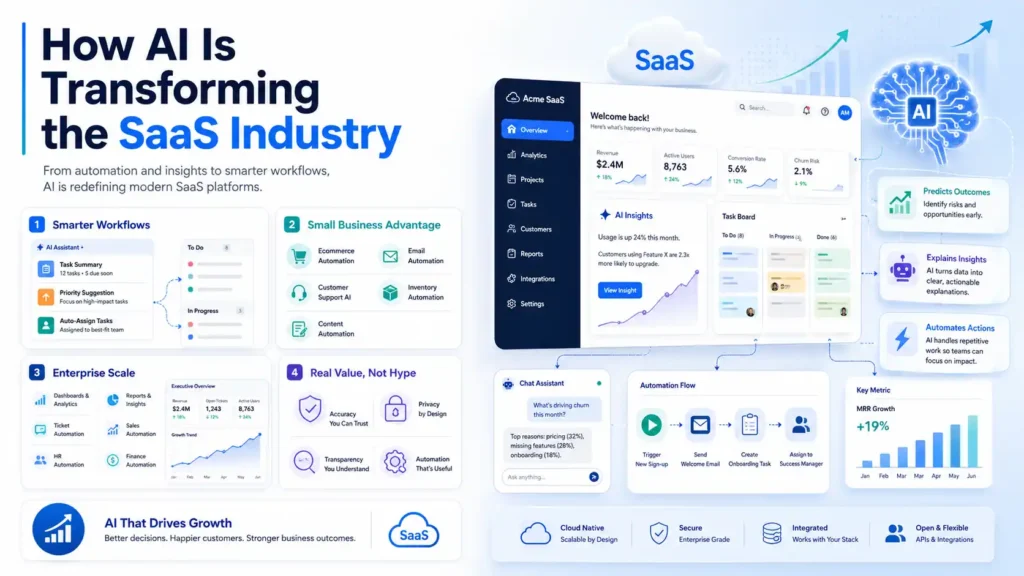
Enterprise companies are also investing heavily in AI SaaS because they need automation at scale. Large companies deal with thousands of customers, employees, reports, documents, tickets, meetings, and workflows. AI SaaS can reduce manual work and improve speed across departments. In customer support, AI chatbots and AI agents can answer routine questions. In sales, AI can score leads and recommend follow-ups. In HR, AI can screen applications and automate onboarding. In finance, AI can detect unusual transactions and prepare reports.
However, SaaS companies must be careful not to use AI only as a marketing buzzword. Customers are becoming smarter, and they can quickly identify tools that add AI labels without real value. The future of AI SaaS will depend on useful automation, accuracy, privacy, and transparency. SaaS platforms that use AI to solve real business problems will grow strongly, while tools that only add weak AI features may struggle to keep customers.
SaaS Pricing, Subscription Models, and Customer Expectations
SaaS pricing models are becoming more flexible as customer expectations change. In the past, simple subscription pricing worked well because customers were comfortable paying a fixed monthly fee. Today, businesses want pricing that matches value. They want to know exactly what they are paying for and how the software helps them grow. This is why SaaS companies are experimenting with freemium plans, tiered pricing, usage-based billing, hybrid pricing, enterprise contracts, and AI credit systems.
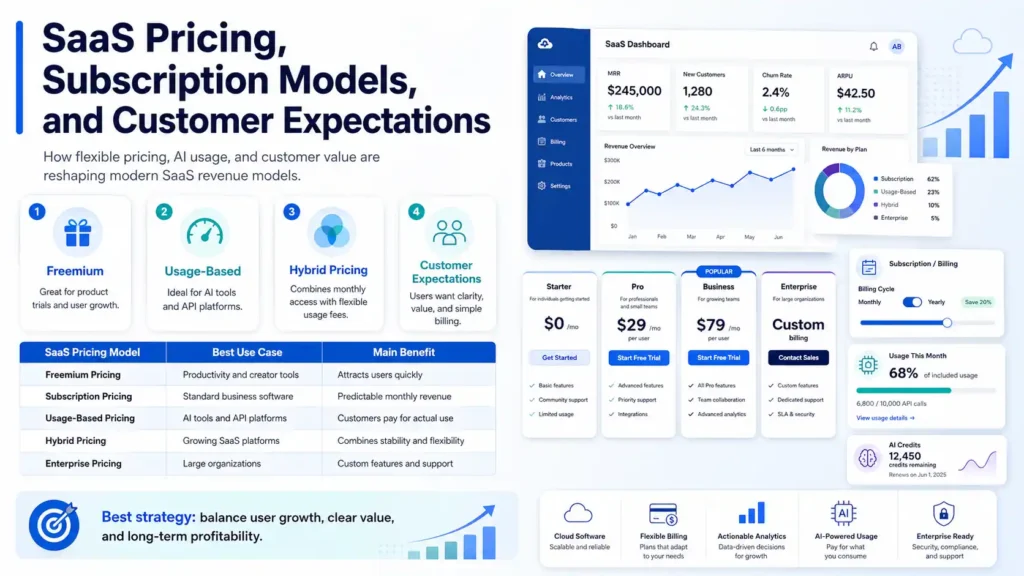
Freemium pricing remains popular because it allows users to test a SaaS product before paying. This works well for productivity, design, and writing tools, as well as small-business apps. However, freemium users must see clear value before upgrading. If the free plan is too limited, users leave. If the free plan gives too much away, the SaaS company may struggle to earn revenue. The best SaaS pricing strategy balances user growth with long-term profitability.
Usage-based pricing is especially important for AI SaaS tools because AI features often cost money to run. For example, generating images, processing documents, running AI models, and using large language models can create real infrastructure costs. This is why many AI SaaS companies use credits, tokens, or metered usage. Customers may like this model because they pay based on how much they actually use, but SaaS companies must keep pricing simple. If users cannot understand the bill, they may lose trust.
Hybrid pricing is becoming one of the strongest models for future SaaS growth. It combines predictable subscription revenue with flexible usage-based charges. For example, a business may pay a monthly base fee for access and then pay extra for more automation runs, AI credits, storage, or transactions. This model works well because small customers can start affordably, while larger customers pay more as they use more value. For SaaS companies, this creates better revenue expansion without forcing every customer into one fixed plan.
| SaaS Pricing Model | Best Use Case | Main Benefit |
| Freemium Pricing | Productivity and creator tools | Attracts users quickly |
| Subscription Pricing | Standard business software | Predictable monthly revenue |
| Usage-Based Pricing | AI tools and API platforms | Customers pay for actual use |
| Hybrid Pricing | Growing SaaS platforms | Combines stability and flexibility |
| Enterprise Pricing | Large organizations | Custom features and support |
SaaS Security, Data Privacy, and Compliance
As SaaS adoption increases, data security becomes one of the most important parts of future SaaS growth. Businesses are no longer using SaaS only for small tasks. They are storing customer records, payment details, contracts, employee information, marketing data, financial documents, private messages, and business strategies inside SaaS platforms. This makes security a serious issue for both SaaS providers and SaaS buyers. A tool may have excellent features, but if it cannot protect data, many businesses will avoid it.
Modern SaaS companies must focus on encryption, secure login, multi-factor authentication, role-based access, data backups, privacy controls, and compliance certifications. Enterprise buyers often ask detailed security questions before purchasing SaaS software. They want to know where data is stored, who can access it, how long it is retained, and what happens during a security incident. This means security is not only an IT feature; it is also a sales advantage. SaaS companies that build strong trust can win bigger customers and longer contracts.
Businesses using SaaS also need better internal management. Many security problems happen because employees use weak passwords, share accounts, connect unknown apps, or forget to remove access when someone leaves the company. This is why SaaS management tools and SaaSOps platforms are becoming more important. Companies need clear visibility into which apps are being used, who has access, how much is being spent, and where risks exist.
The future of SaaS security will likely include more AI-based monitoring, automatic risk detection, smarter access management, and stronger compliance automation. As regulations become stricter and cyber threats become more advanced, SaaS companies that take security seriously will stand out. Customers will not only ask, “What features does this software have?” They will also ask, “Can I trust this platform with my business data?”
SaaS Consolidation and Cost Optimization
One of the most practical SaaS trends today is SaaS consolidation. Over the last few years, many companies adopted too many cloud tools. One team used one app for communication, another used a different project management tool, marketing used several automation platforms, sales used multiple CRM add-ons, and finance had its own subscriptions. At first, this looked like flexibility. Over time, it created confusion, duplicate features, scattered data, rising costs, and security risks.
Now businesses are becoming more careful. They are auditing their SaaS stack and asking which tools are truly useful. If two tools do the same job, one may be removed. If a platform has unused licenses, the company may reduce seats. If an expensive SaaS tool does not show clear return on investment, it may be replaced. This does not mean SaaS demand is dying. It means SaaS buying is becoming smarter, more strategic, and more focused on value.
For SaaS companies, this trend is very important. Customers are no longer impressed by simple features alone. They want proof that the software saves money, improves productivity, increases revenue, or reduces manual workload. This is why customer success, onboarding, reporting, and measurable ROI are becoming key parts of SaaS growth. A SaaS company that helps customers see value quickly will have better retention and lower churn.
SaaS consolidation also creates opportunities for all-in-one platforms. Businesses may prefer tools that combine CRM, email marketing, automation, reporting, and customer support in one system. However, specialized SaaS tools can still succeed if they solve a painful problem better than a larger platform. The real winner will be the SaaS product that delivers strong value, integrates well, and fits naturally into the customer’s workflow.
Future Growth Opportunities for SaaS Businesses
The future of SaaS offers huge opportunities, but competition is also rising. New SaaS founders cannot rely on generic ideas anymore. The best growth opportunities are in AI automation, vertical SaaS, micro SaaS, cybersecurity SaaS, workflow automation, no-code platforms, customer support automation, financial SaaS, healthcare SaaS, education SaaS, and eCommerce SaaS. These areas are growing because businesses want software that solves specific problems instead of broad tools that do everything lightly.
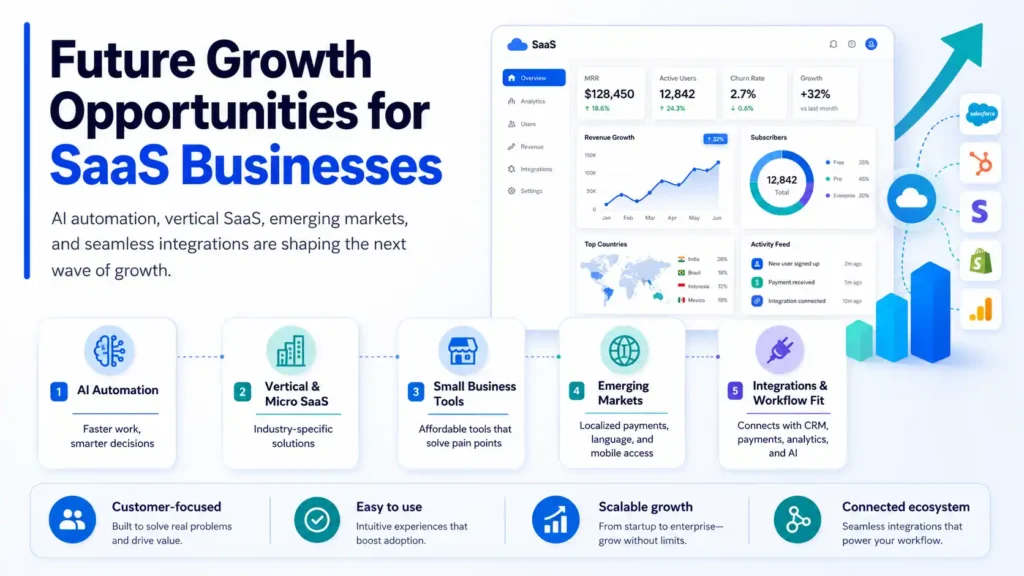
Small businesses are one of the biggest future growth markets for SaaS. Many small companies want affordable tools that help them manage customers, create content, accept payments, track orders, schedule appointments, send emails, design graphics, and analyze performance. They do not want complicated enterprise software. They want simple, affordable, easy-to-use SaaS platforms that produce results quickly. This creates strong opportunities for SaaS companies that understand small business pain points.
Emerging markets are another major opportunity. As internet access improves and digital payments grow in Asia, Africa, the Middle East, and Latin America, more businesses will adopt SaaS tools. However, global SaaS companies must localize properly. They need local language support, local payment options, mobile-friendly interfaces, and pricing that fits regional budgets. A SaaS product that works well in the United States may need changes before succeeding in Pakistan, India, UAE, Brazil, or Indonesia.
The next wave of SaaS growth will also come from better integrations. Businesses do not want isolated tools that create data silos. They want SaaS platforms that connect with CRMs, websites, payment gateways, accounting tools, calendars, AI assistants, communication apps, and analytics dashboards. The more smoothly a SaaS tool fits into the existing business system, the more valuable it becomes. Future SaaS winners will not only offer features; they will become part of the customer’s daily workflow.
How Businesses Can Prepare for the Future of SaaS
Businesses that want to benefit from SaaS future growth should start with a clear software strategy. The first step is to review current SaaS tools and identify what is useful, what is duplicated, and what is wasting money. Many companies pay for software they barely use. A proper SaaS audit can reduce cost and improve productivity at the same time. This is especially important as subscription costs rise and AI-powered features become more common.
The second step is to focus on integration. A SaaS tool should not work alone like an island. It should connect with the company’s existing systems and make work easier. For example, a CRM should connect with email marketing, customer support, website forms, sales dashboards, and automation tools. When software tools communicate with each other, teams save time and avoid manual data entry. This is where SaaS creates real business value.
The third step is to evaluate AI features carefully. Businesses should not buy AI SaaS only because it sounds modern. They should ask practical questions. Does this AI feature save time? Does it improve accuracy? Does it reduce workload? Does it create a better customer experience? Does it protect data? If the answer is yes, the tool may be worth the investment. If the answer is unclear, the business should test before committing.
The final step is to choose SaaS platforms that can scale. A tool may work for a small team today, but will it still work when the company grows? Can it support more users, more data, more automation, and more security needs? SaaS should support business growth, not block it. Companies that choose scalable, secure, and value-driven software will be better prepared for the future.
FAQs
Q1. What are the top SaaS trends in 2026?
The top SaaS trends in 2026 include AI-powered SaaS, vertical SaaS, usage-based pricing, SaaS security, automation, and SaaS cost optimization. These trends are helping businesses use smarter and more flexible cloud software.
Q2. Why is SaaS important for businesses?
SaaS is important for businesses because it reduces software costs, improves productivity, supports remote work, and gives companies easy access to powerful cloud-based tools without complex installation.
Q3. What is the future of SaaS?
The future of SaaS is focused on AI automation, secure cloud platforms, flexible pricing, industry-specific software, and better business integrations. SaaS will continue growing as more companies move online.
Q4. How is AI changing SaaS?
AI is changing SaaS by helping software tools automate tasks, analyze data, generate content, answer customer questions, and improve business decisions faster.
Q5. What is vertical SaaS?
Vertical SaaS is software designed for a specific industry, such as healthcare, real estate, education, finance, or logistics. It is growing because businesses need more targeted and practical solutions.
Q6. Is SaaS better than traditional software?
Yes, SaaS is better than traditional software for many businesses because it is cloud-based, easy to use, automatically updated, and accessible from anywhere.
Q7. What is usage-based SaaS pricing?
Usage-based SaaS pricing means customers pay according to how much they use the software, such as storage, users, AI credits, API calls, or transactions.
Q8. Why is SaaS security important?
SaaS security is important because businesses store customer data, payment details, documents, and private information inside cloud software. Strong security protects data from cyber risks.
Q9. How can businesses reduce SaaS costs?
Businesses can reduce SaaS costs by removing unused tools, canceling duplicate subscriptions, reducing extra user seats, and choosing software that gives real value.
Q10. Is SaaS still profitable?
Yes, SaaS is still profitable when the product solves a real problem, keeps customers satisfied, offers strong security, and provides clear business value.
Q11. What should businesses check before buying SaaS software?
Before buying SaaS software, businesses should check pricing, features, security, integrations, ease of use, customer support, and scalability.