
Generative AI tools are no longer a futuristic concept — they are the driving force behind creativity, productivity, and business innovation in 2026. From creating compelling content to generating images, videos, and even code, these tools have become essential for creators, marketers, developers, and educators alike. If you’ve been curious about AI software, AI content creation, or AI productivity tools, this is your ultimate guide to the top generative AI tools you can’t ignore this year.
The AI landscape has evolved dramatically over the past few years. Early tools were impressive, showcasing what AI could potentially achieve, but they were often limited in scope, reliability, and usability. Fast forward to 2026, and today’s generative AI platforms are smarter, faster, and more human-like than ever before. They are capable of understanding context, interpreting natural language prompts with nuance, and delivering outputs that often require minimal human editing. This means tasks that once took hours or even days — like drafting blog posts, creating marketing campaigns, designing graphics, or writing software code — can now be accomplished in a fraction of the time, without compromising quality.
What makes these tools so transformative is not just speed, but their ability to enhance human creativity and problem-solving. Imagine brainstorming dozens of creative ideas in minutes, generating unique visuals that fit your brand style, or testing multiple software prototypes simultaneously — generative AI makes all of this possible. Businesses are now using these tools to automate workflows, scale operations, and create personalized customer experiences, while content creators can focus on strategy and storytelling rather than repetitive technical tasks.
Moreover, generative AI has democratized technology. You no longer need to be a professional designer, developer, or data scientist to leverage cutting-edge AI capabilities. User-friendly platforms with intuitive interfaces allow anyone — from entrepreneurs to educators — to generate professional-quality content and insights with minimal technical knowledge. This accessibility is reshaping industries by leveling the playing field and allowing smaller teams or individual creators to compete with larger organizations.
In this article, we’ll dive deep into the best generative AI tools of 2026, covering text generation, AI-powered image creation, video tools, and code assistants. We’ll also explore practical ways to use these platforms to boost productivity, unleash creativity, and streamline workflows, helping you harness AI’s full potential in your personal and professional life.
What Is Generative AI?
At its core, generative AI refers to artificial intelligence systems capable of creating new content. Unlike traditional AI, which focuses on analyzing or predicting data, generative AI produces text, images, videos, and even software code based on patterns learned from vast datasets.
Think of generative AI as a digital creative partner. Need a blog written in an hour? AI can draft it. Want a social media image or an animated video? AI can generate that too. The applications are nearly limitless, which is why generative AI tools are rapidly becoming essential for businesses, creators, and educators alike.
By 2026, these tools will have moved from experimental technology to mainstream applications. They’re no longer reserved for developers or large enterprises — even small businesses and individual creators can leverage their power.
Why Generative AI Tools Are Essential in 2026
The influence of generative AI tools is enormous, and here’s why you need to pay attention in 2026:
- Scale Creativity: Tasks like content creation, graphic design, or idea generation are accelerated exponentially. What took hours now takes minutes.
- Increase Productivity: Automating repetitive workflows allows teams and individuals to focus on strategy, innovation, and high-impact tasks.
- Boost Personalization: Generative AI can tailor content and experiences for individual users, making marketing, learning, and user engagement far more effective.
- Cost Efficiency: Businesses save on resources and reduce dependency on large teams, while small creators can produce professional-quality content with minimal investment.
- Foster Innovation: Rapid prototyping, idea testing, and experimentation are easier, allowing for faster iteration cycles and more agile strategies.
Companies that adopt AI productivity tools report higher engagement, faster content production, and a competitive edge over those relying on traditional methods.
Top Generative AI Tools in 2026
Generative AI has branched into multiple domains, each with tools optimized for specific types of content and workflows. Let’s break them down:
1. Large Language Models (LLMs) — AI Text and Content Creation
Text generation remains one of the most powerful use cases of generative AI. Large Language Models (LLMs) have grown more sophisticated, accurate, and context-aware, making them the cornerstone of AI-driven content creation.
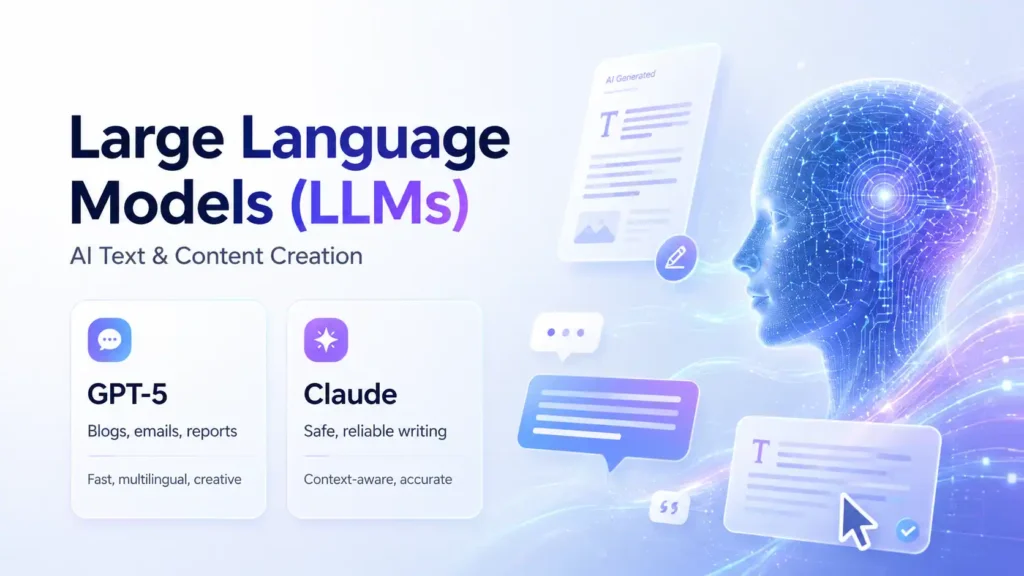
OpenAI GPT-5
Capabilities: Writes blog posts, marketing copy, reports, essays, emails, and more.
Why It Matters: GPT-5 can reduce writing time by up to 70% and supports multi-language outputs. Its integration with tools like Notion AI or ChatGPT plugins allows seamless content creation for businesses and individuals.
SEO Keywords: GPT-5 AI tool, AI text generator 2026, AI content creation software.
Capabilities: Produces contextually accurate and safe text outputs.
Why It Matters: Claude AI focuses on ethical and reliable outputs, which is crucial for sensitive tasks like HR, compliance, or customer communication.
SEO Keywords: Claude AI assistant, ethical AI 2026, AI writing platform.
2. AI Image Generators — Visual Content Revolution
Generative AI has completely transformed visual content creation. AI image generators now produce photorealistic images and stylized art suitable for professional use.
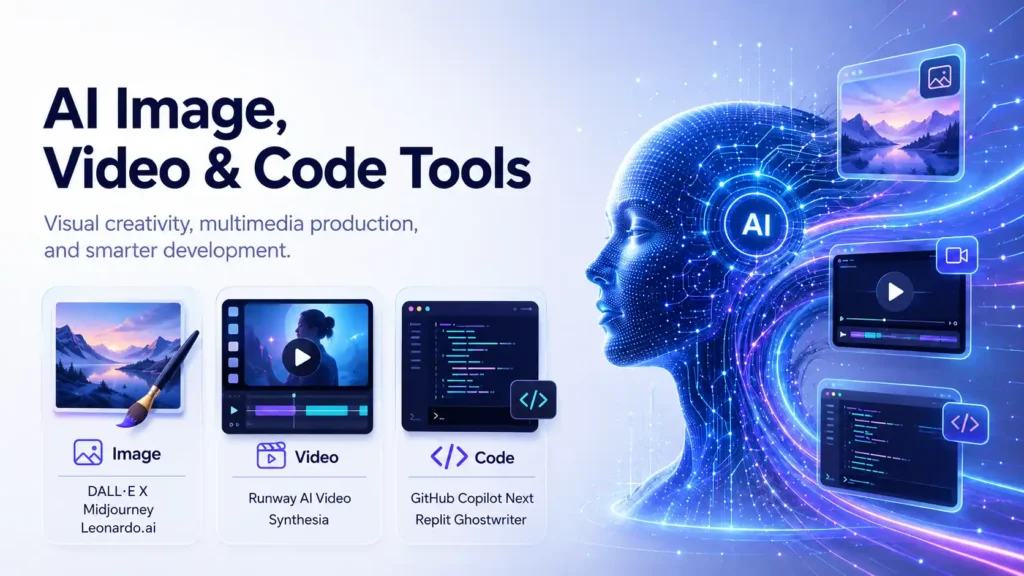
DALL-E X
Capabilities: Generates high-resolution, customizable images based on text prompts.
Use Cases: Product mockups, social media graphics, advertising visuals, and concept art.
SEO Keywords: AI image generator 2026, best AI design tools, AI graphics software.
Capabilities: Focused on artistic and creative visuals for designers, marketers, and digital creators.
SEO Keywords: AI art generator, AI design tool, creative AI software 2026.
3. AI Video Tools — Transforming Multimedia Content
Video has become the most engaging medium online, and generative AI simplifies production and editing.
Capabilities: Converts text prompts into fully edited videos, animates scenes, and replaces backgrounds seamlessly.
SEO Keywords: AI video generator 2026, AI video editing tool, AI content video.
Capabilities: Uses AI avatars and multilingual voiceovers for corporate training, explainer videos, and marketing content.
SEO Keywords: AI video platform, AI avatar video software, AI-generated videos.
4. AI Coding Assistants — Smarter Software Development
Coding productivity has been transformed by AI code assistants, helping developers write, debug, and optimize code faster.
GitHub Copilot Next
Capabilities: Predicts code completions, generates documentation, and suggests unit tests.
SEO Keywords: AI coding assistant 2026, AI programming software, developer AI tools.
Replit Ghostwriter
Capabilities: Provides real-time coding suggestions, debugging help, and prototyping support.
SEO Keywords: AI code generator, AI programming assistant, coding AI tools.
5. AI for Business — Automating Operations and Insights
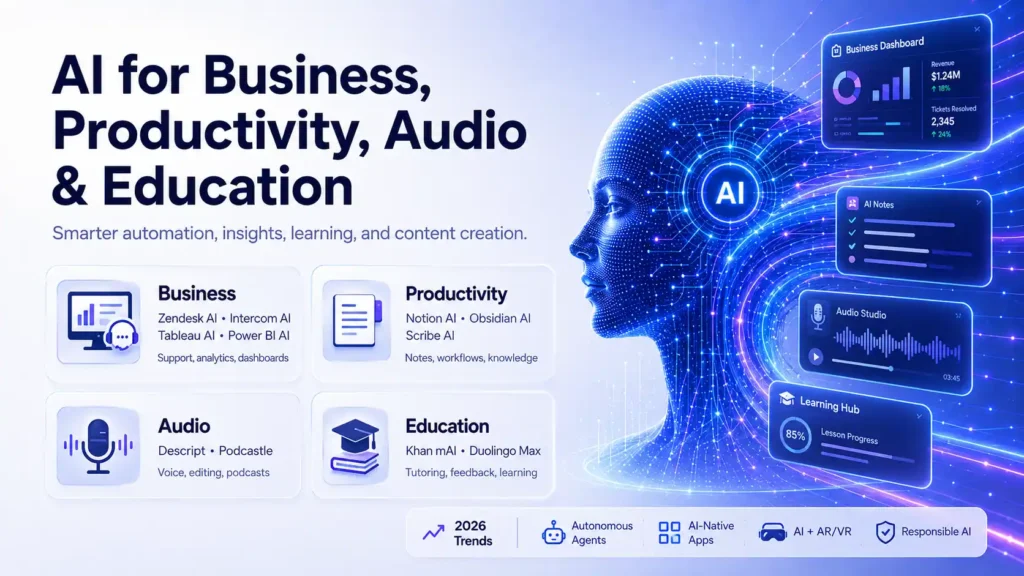
Generative AI is increasingly integrated into enterprise workflows, from customer support to analytics.
AI Customer Support Tools (Zendesk AI, Intercom AI)
Capabilities: Automate repetitive customer queries, generate personalized responses, and update CRM records automatically.
SEO Keywords: AI customer support 2026, AI business automation tools, AI helpdesk software.
AI Analytics Tools (Tableau AI, Power BI AI)
Capabilities: Summarizes data, predicts trends, and creates visual dashboards with narrative insights.
SEO Keywords: AI analytics software, AI business intelligence 2026, AI data insights.
6. AI Productivity & Knowledge Management Tools
AI tools for productivity help teams organize ideas, automate documentation, and generate insights.
Notion AI & Obsidian AI
Capabilities: Summarize notes, create structured knowledge databases, and automate workflows.
SEO Keywords: AI productivity tools, AI note-taking software 2026, AI knowledge management.
Scribe AI
Capabilities: Quickly generates training guides, tutorials, and educational content.
SEO Keywords: AI learning tools, AI content automation software.
7. AI Audio & Podcast Tools
AI tools now make audio content creation faster and more professional.
Descript & Podcastle
Capabilities: Convert text to audio, edit voice recordings with natural language, and generate podcasts.
SEO Keywords: AI podcast tools, AI voice generator 2026, AI audio production software.
8. AI in Education
Generative AI is changing learning experiences with personalized content and adaptive teaching methods.
AI Tutors (Khan mAI, Duolingo Max)
Capabilities: Provide customized learning paths, real-time feedback, and interactive exercises.
SEO Keywords: AI learning tools, AI education software, AI study assistant.
Trends Shaping Generative AI in 2026
- Autonomous AI Agents: Perform multi-step tasks without constant human input.
- AI-Native Applications: Software built from the ground up with AI at its core.
- AI + AR/VR: Real-time augmented experiences for education, marketing, and entertainment.
- Responsible AI Practices: Bias mitigation, ethical outputs, and explainable results are becoming mandatory.
Businesses and creators who adopt these trends early will gain a significant competitive advantage.
Challenges to Consider
While generative AI is transformative, some challenges remain that every user and business should carefully consider before adopting these tools at scale.
- Data Privacy: Generative AI tools often require access to sensitive data, whether it’s business documents, customer information, or proprietary content. Ensuring that your AI platform has robust data encryption, secure storage, and compliance with regulations like GDPR is essential. Failing to protect data can lead to breaches, legal liabilities, and reputational damage, which are risks no organization can afford in 2026.
- Accuracy & Hallucinations: Even the most advanced AI can produce outputs that are factually incorrect or misleading, commonly referred to as “hallucinations.” For instance, a generative AI tool may write a convincing article, draft code, or generate a report that contains subtle errors. Users must cross-check AI-generated content before publishing or implementing it, especially in critical areas like finance, healthcare, or technical documentation.
- Ethical Concerns: AI models are trained on vast datasets that may include biased or harmful content. Without proper monitoring, AI outputs could unintentionally perpetuate stereotypes, misinformation, or unethical messaging. Businesses and content creators need to implement bias detection tools, content review processes, and ethical guidelines to ensure responsible use.
- Human Oversight: While AI can automate repetitive and time-consuming tasks, it cannot replace human judgment, creativity, or strategic thinking. Decisions based solely on AI recommendations may overlook context, nuance, or long-term implications. Maintaining a human-in-the-loop approach ensures that AI remains a support tool rather than a replacement for critical thinking.
- Integration & Technical Challenges: Incorporating AI tools into existing workflows or legacy systems can sometimes be challenging. Organizations may face compatibility issues, learning curves, or additional infrastructure costs. Careful planning, training, and selecting AI platforms that integrate smoothly can mitigate these challenges.
By addressing these factors proactively, individuals and organizations can maximize the benefits of generative AI while minimizing potential risks. Responsible adoption ensures not only higher productivity and creativity but also sustainable and ethical outcomes in the rapidly evolving AI landscape.