
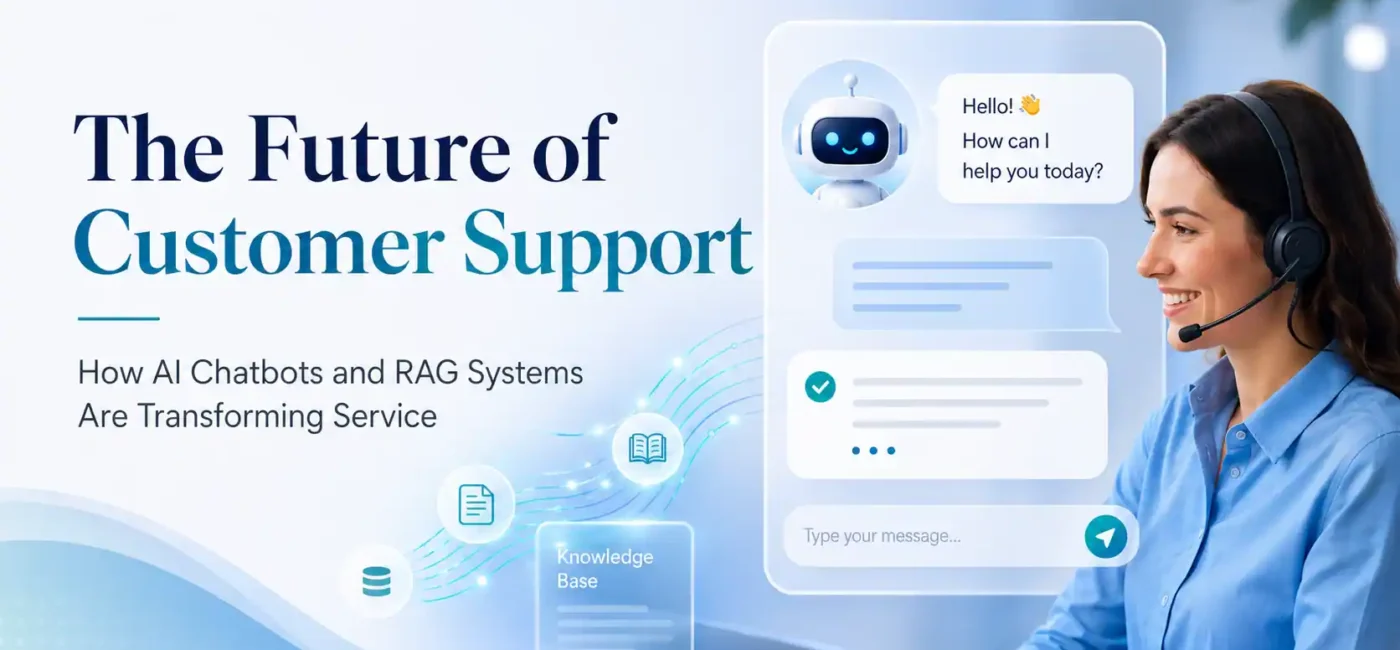
In 2026, customer support isn’t just changing — it’s being rebuilt from the ground up by artificial intelligence. Gone are the days of rigid decision-tree bots that frustrate customers with canned replies, endless menus, and repetitive questions. Today’s AI-powered chatbots and Retrieval-Augmented Generation (RAG) systems are transforming how businesses respond, assist, and delight customers — and this transformation is only accelerating. These systems aren’t just about faster responses anymore; they are about smarter, context-aware, and personalized interactions that make customers feel understood, valued, and supported.
Whether you’re a business owner looking to improve your customer satisfaction scores, a support leader aiming to reduce operational costs, or a tech enthusiast following AI innovations, understanding this shift is essential. Modern customers expect near-instant answers, seamless omnichannel experiences, and proactive solutions — and AI is the only technology capable of delivering this consistently at scale. By leveraging AI chatbots powered by natural language understanding, companies can remember customer preferences, predict common issues, and even suggest solutions before the user asks, creating a service experience that feels both effortless and highly personal.
RAG systems take this to another level by ensuring that the answers generated by AI are always accurate and grounded in the company’s knowledge base, policies, product manuals, and FAQs. This minimizes misinformation, reduces follow-up queries, and builds customer trust — a key differentiator in today’s competitive landscape. Businesses are increasingly integrating these systems not as a replacement for human agents, but as powerful assistants that empower agents to focus on complex, high-value interactions while routine queries are handled autonomously.
Moreover, the adoption of AI in support is not only improving efficiency but also reshaping expectations. Customers now expect intelligent self-service portals, instant multi-channel support, and solutions that understand not just what they are asking but also the context of their problem. Companies that embrace AI-powered support early are already seeing measurable benefits: faster ticket resolution, lower operational costs, and higher Net Promoter Scores (NPS).
Let’s explore what this future of AI-driven customer support looks like, why it matters for every organization, and how chatbots and RAG systems are leading the charge in creating seamless, personalized, and proactive experiences that delight customers and redefine support standards.
The AI Revolution in Customer Support
At a macro level, AI is no longer experimental in customer support — it’s essential. According to a 2026 survey of service and support leaders, 91% feel pressure from executives to implement AI to improve customer satisfaction, operational efficiency, and overall business performance. Organizations are realizing that relying solely on human agents for repetitive tasks is no longer sustainable in today’s fast-paced, digitally connected world.
This shift means businesses aren’t asking whether they should adopt AI anymore — they’re asking how fast, how deeply, and how effectively they can integrate it into their support ecosystems. And for good reason: modern AI systems drastically cut operational costs, accelerate response times, enable 24/7 support, and deliver hyper-personalized experiences that customers now expect as standard. In fact, companies leveraging AI-powered chatbots and RAG systems report higher retention rates, fewer escalations, and improved brand loyalty, proving that AI isn’t just a technology investment — it’s a strategic imperative for customer-centric businesses in 2026.
From Scripted Chatbots to Smart AI Agents
If you’ve used a chatbot any time in the last decade, you know the frustration — repeated questions, dead‑end replies, and long wait times for human help. These older bots worked strictly by rules and static scripts. But 2026’s AI chatbots are fundamentally different.
What Today’s AI Can Do
Modern AI chatbots:
- Understand natural language and context, not keywords
- Remember past interactions, so customers don’t repeat themselves
- Manage multi‑step tasks like processing refunds, booking appointments, or escalating tickets to humans
- Interact across text, voice, images, and video — all within the same conversation
In other words, chatbots are no longer simple responders — they’re smart, multitasking agents that can act on behalf of customers and businesses alike.
The Rise of RAG: Making AI Accurate
Retrieval‑Augmented Generation (RAG) is one of the most powerful trends in modern AI support systems.
Instead of relying solely on a language model’s internal memory — which can hallucinate or guess — RAG systems pull accurate data from company documents, FAQs, knowledge bases, product catalogs, and policy pages before generating answers. This combination improves accuracy drastically and reduces misinformation.
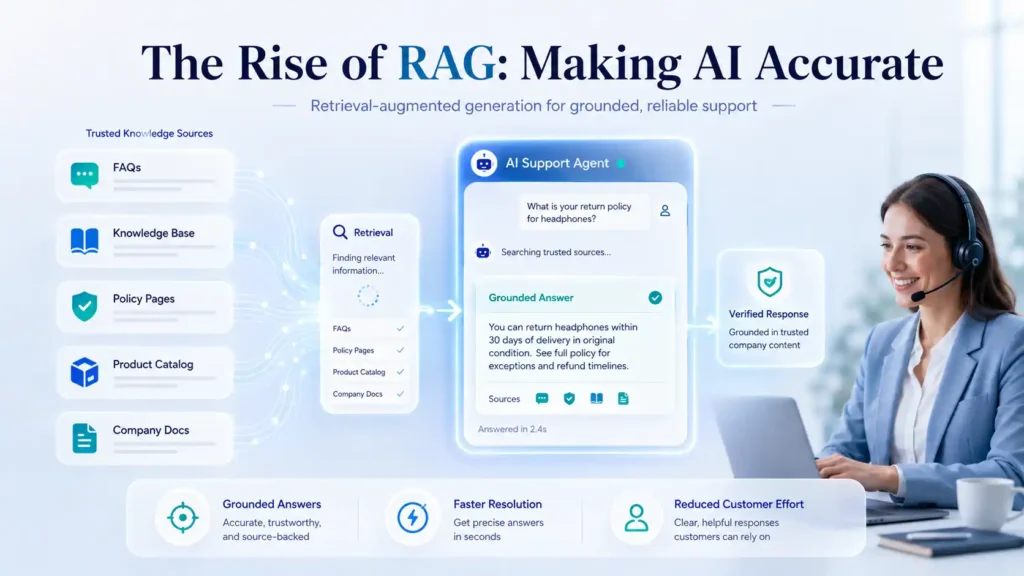
Here’s how RAG boosts support quality:
- Grounded Answers – Responses are tied directly to real knowledge sources.
- Faster Resolution – Agents spend less time searching manually and more time helping customers.
- Reduced Customer Effort – Customers get reliable answers without repetition or confusion.
In simple terms: RAG pulls facts, and AI uses those facts to generate correct, helpful answers. That’s why support teams are rapidly adopting RAG systems to minimize bot hallucinations and boost customer trust.
Proactive Support: AI That Predicts the Problem
One of the most exciting breakthroughs in support AI is proactive assistance. Instead of waiting for a customer to ask a question, AI systems are now spotting friction and solving it before help is requested.
Imagine a bot that:
- Notices abandoned carts and nudges the customer with a helpful message
- Detects dissatisfaction in messaging tone and offers priority escalation
- Reviews recent activity and suggests solutions to recurring issues
This type of predictive support isn’t futuristic — it’s happening in 2026 and giving companies a major competitive edge.
Hybrid Human + AI Workflows: The New Standard
Despite massive automation, humans are still a critical part of support — especially for complex or emotionally charged interactions. Best‑in‑class organizations are now using a hybrid model where:
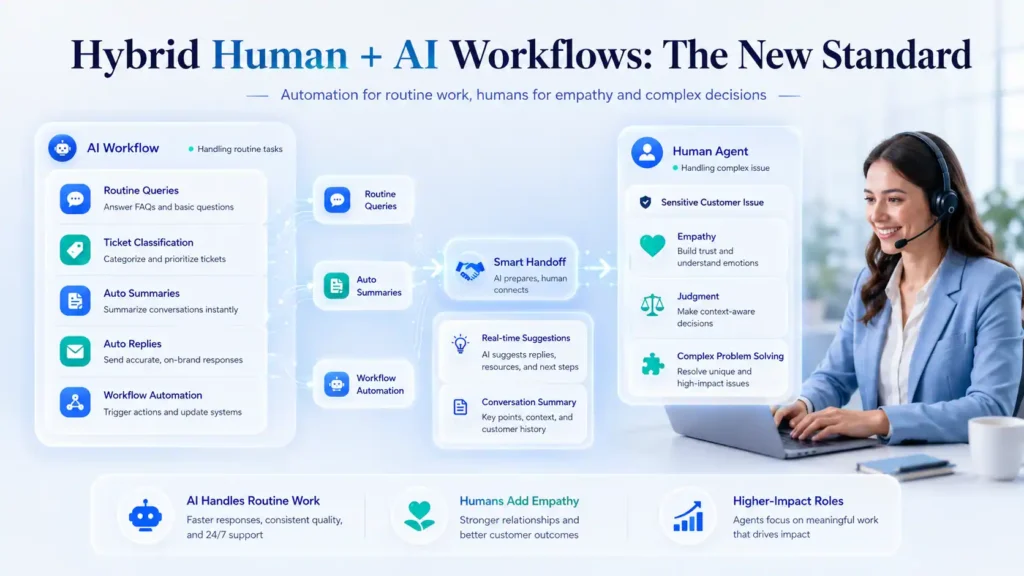
- AI handles routine queries and workflows
- Humans focus on empathy, judgment, and nuanced problem solving
- AI supports human agents with real‑time suggestions and summaries
This hybrid approach preserves customer satisfaction while maximizing efficiency. Gartner research shows that human agents are increasingly being retrained into higher‑impact roles, such as knowledge management and quality assurance, rather than being replaced entirely.
Multimodal AI: Beyond Text to Voice and Vision
Another crucial trend: multimodal understanding. Instead of only handling text, AI is now capable of processing:
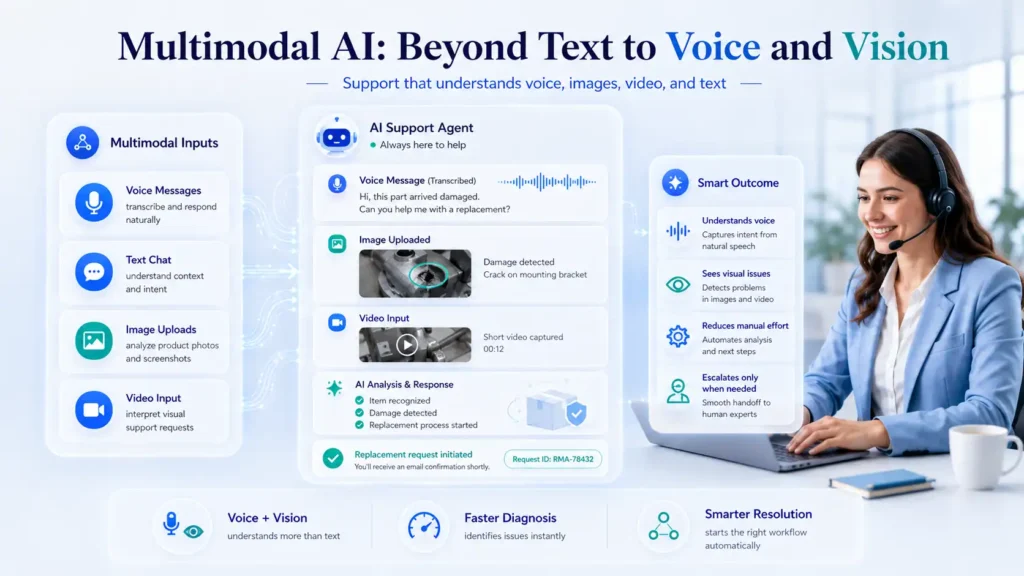
- Voice messages — transcribing and responding in natural language
- Images — analyzing uploaded product photos or screenshots
- Video — offering intelligent support based on visual input
For example, a customer can upload a picture of a damaged part, and the chatbot will recognize the item, identify the damage, and start a replacement process — all without involving a human until necessary.
That’s not just support — that’s contextual problem solving.
AI for Self‑Service: Empowering Customers Directly
Self‑service used to mean static FAQ pages and confusing navigation menus. Today, AI drives dynamic, intelligent self‑service that can:
- Understand complex questions
- Suggest tailored help articles
- Deliver instant, conversational responses
- Automatically update help content based on real usage
Companies that invest in AI‑driven self‑service see higher satisfaction and fewer support tickets — freeing human agents for more strategic tasks.
When AI Goes Wrong: Challenges and Trust Issues
Not all customers love AI. Recent surveys indicate that many users still distrust AI‑only support, with a large percentage preferring human interactions when things become complicated.
Here’s the reality:
- AI bots boost efficiency, but poor implementations can frustrate users.
- Overconfidence and wrong answers erode trust.
- Customers often want access to a human backup when needed.
The key isn’t avoidance — it’s integration. AI must be reliable, transparent, and designed so humans can intervene seamlessly. Customer trust improves when AI augments support instead of replacing human care entirely.
What’s Next: Agentic AI and Autonomous Workflows
While RAG and chatbots are transforming support today, the next big shift is agentic AI — systems that don’t just respond but execute workflows autonomously. These AI agents can:
- Initiate refunds
- Schedule service appointments
- Update customer accounts
- Escalate complex issues exactly when needed
In other words, they act more like digital employees than simple chat tools. Organizations that adopt agentic AI will see deeper automation and faster customer resolution rates, with humans acting as supervisors rather than day‑to‑day responders.
Customer Support AI Tools
Customer support AI tools help businesses respond faster, reduce repetitive work, and improve the overall customer experience. These tools use chatbots, automation, knowledge bases, and AI-powered ticketing systems to answer common questions, guide users, and support human agents.
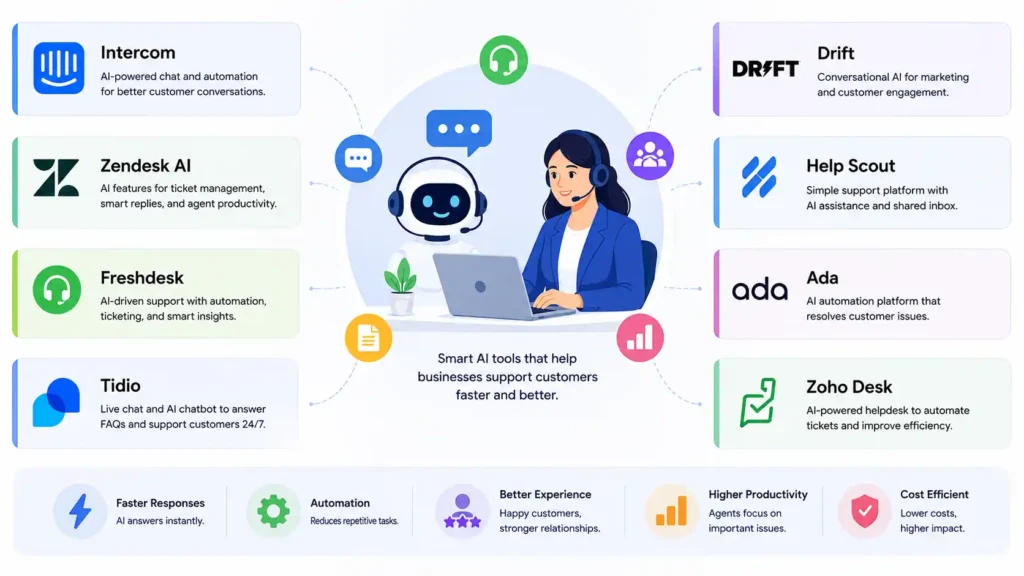
Some popular customer support AI tools include:
1. Intercom
Intercom is a customer messaging and AI support platform. It helps businesses use AI chatbots, live chat, and automated workflows to answer customer questions and manage support conversations.
2. Zendesk AI
Zendesk AI helps support teams manage tickets, suggest replies, summarize conversations, and automate common customer service tasks. It is useful for larger teams handling many support requests.
3. Freshdesk
Freshdesk provides customer support software with AI features for ticket management, automation, and faster responses. It helps agents prioritize issues and improve service quality.
4. Tidio
Tidio is a live chat and chatbot tool for websites, especially useful for small businesses and ecommerce stores. Its AI chatbot can answer FAQs, assist shoppers, and collect customer information.
5. Drift
Drift focuses on conversational marketing and customer engagement. It helps businesses chat with website visitors, qualify leads, and provide quick support through AI-powered conversations.
6. Help Scout
Help Scout is a simple customer support platform with shared inbox, knowledge base, and AI assistance. It is useful for teams that want a clean and human-friendly support experience.
7. Ada
Ada is an AI customer service automation platform. It helps businesses build automated support experiences that can answer questions, resolve issues, and reduce the need for manual agent involvement.
8. Zoho Desk
Zoho Desk is a customer service tool with AI assistant features. It helps manage tickets, automate replies, track customer issues, and improve support team productivity.
9. Salesforce Service Cloud
Salesforce Service Cloud offers AI-powered customer service features for large organizations. It supports case management, automation, customer data insights, and agent assistance.
10. HubSpot Service Hub
HubSpot Service Hub helps businesses manage customer tickets, live chat, knowledge bases, and support automation. It is useful for companies already using HubSpot CRM.
Overall, customer support AI tools are becoming essential because they help businesses provide faster, smarter, and more personalized support while allowing human agents to focus on complex and high-value customer issues.
Security and Data Considerations
With great AI power comes great responsibility. Systems that access internal knowledge and customer data must be secure, compliant, and respectful of privacy. That’s where design choices like secure RAG setups and strict access controls matter most.
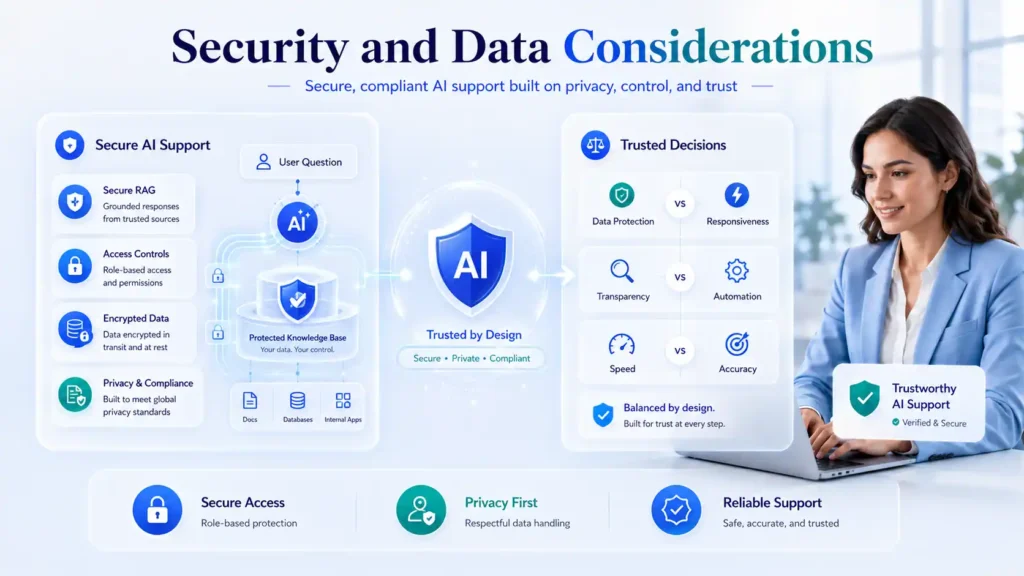
Enterprises must balance:
- Data protection vs. responsiveness
- Transparency vs. automation
- Speed vs. accuracy
Getting this balance right will be a defining factor for trustworthy AI support systems in 2026 and beyond.
Frequently Asked Questions (FAQs)
What is a RAG system, and why is it important for support accuracy?
RAG (Retrieval-Augmented Generation) systems combine AI language models with real-time data retrieval from knowledge bases, product catalogs, and FAQs. This ensures that responses are factual, accurate, and grounded in company information, minimizing misinformation.
Can AI replace human agents entirely in customer service?
No. While AI handles repetitive and routine queries, humans are essential for complex issues, empathetic communication, and decision-making. Most successful businesses use hybrid workflows, where AI supports humans rather than replacing them.
How does AI-driven customer support save companies money?
AI reduces operational costs by automating up to 70% of routine queries, lowering ticket volumes, speeding up resolution times, and allowing human agents to focus on higher-value tasks. Self-service AI also reduces dependency on large support teams.
Are AI chatbots safe for handling sensitive customer data?
Yes, when designed with proper security measures, access controls, and compliance protocols. Modern AI systems encrypt data and maintain privacy standards while providing real-time assistance, making them safe for sensitive transactions.
How do AI chatbots handle multiple communication channels?
Modern AI chatbots support omnichannel engagement, meaning customers can switch between email, live chat, messaging apps, and social media without losing conversation context. The AI remembers previous interactions to provide seamless support.
What is proactive customer support with AI?
Proactive AI identifies potential issues before a customer asks for help — for example, sending alerts for abandoned carts, predicting service failures, or notifying users of delayed orders. This improves customer experience and reduces support tickets.
How does AI understand images, videos, or voice for support?
Multimodal AI can analyze uploaded images, video clips, or voice messages to diagnose problems, suggest solutions, or initiate workflows. For example, a photo of a damaged product can trigger an automatic replacement request.
Will implementing AI chatbots frustrate my customers?
If poorly implemented, yes. However, AI that is accurate, transparent, and integrated with human backup reduces frustration. Customers appreciate fast, reliable, and contextual support rather than rigid, scripted bots.
What future trends should I watch in AI customer support?
Look out for agentic AI that can autonomously execute tasks, advanced multimodal AI handling text, voice, and images, and further personalization with predictive analytics. Companies adopting these trends see higher satisfaction and lower operational costs.