
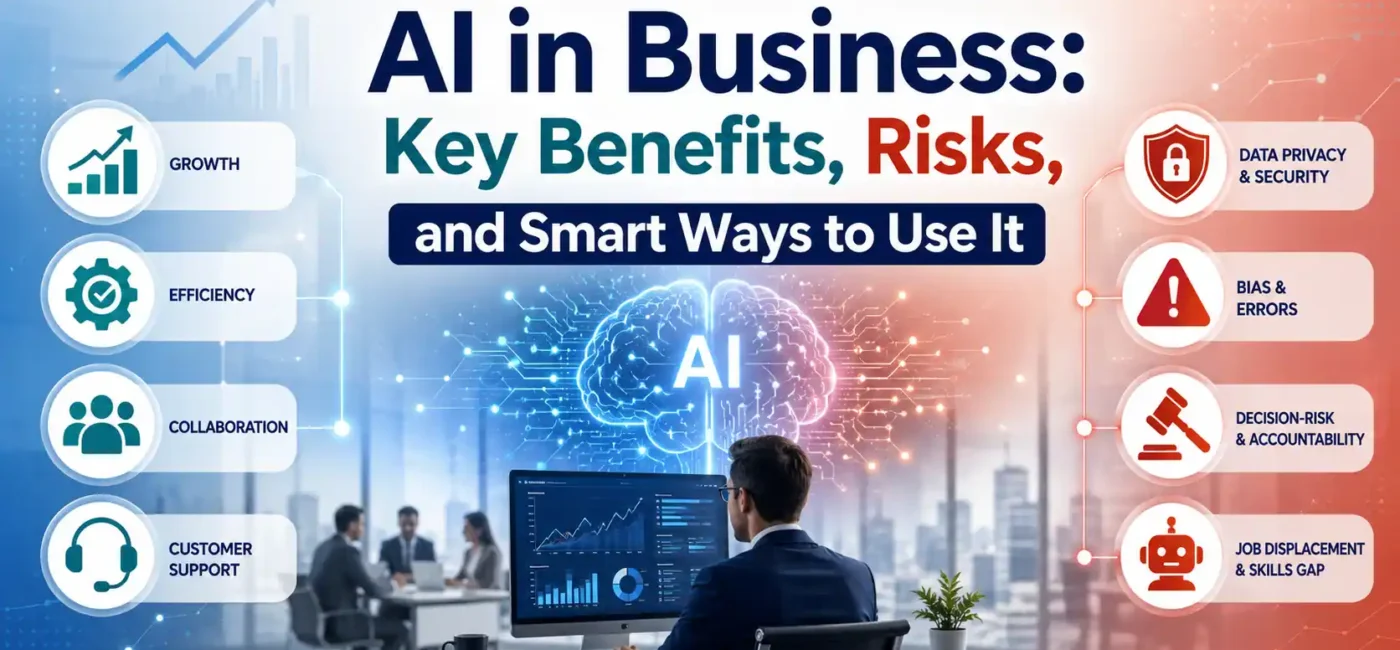
AI in business is no longer a futuristic idea. It is already changing how companies work, sell, market, support customers, and make decisions. From small online stores to large enterprises, businesses are using AI tools to save time, reduce costs, improve productivity, and create better customer experiences. Whether it is an AI chatbot answering customer questions, an AI writing tool creating product descriptions, or an analytics system predicting sales trends, artificial intelligence is becoming part of everyday business operations.
The reason AI is growing so quickly is simple: businesses want faster results with fewer manual tasks. Customers expect quick replies, personalized recommendations, and smooth digital experiences. Employees also want tools that help them avoid repetitive work and focus on creative, strategic, and high-value tasks. Stanford’s 2026 AI Index reported that generative AI reached nearly 53% population-level adoption within three years, showing how quickly AI has moved into daily life and work. It also reported that global corporate AI investment more than doubled in 2025.
Still, AI is not perfect. It can produce wrong answers, expose sensitive data, create bias, affect jobs, and raise legal or ethical concerns. That is why every business owner, manager, marketer, and professional should understand both the benefits of AI in business and the risks of AI in business. AI is like a powerful engine: it can move your business forward quickly, but only if you know how to control it.
What Is AI in Business?
Artificial intelligence in business means using smart computer systems to perform tasks that normally require human thinking. These tasks may include writing, data analysis, customer support, fraud detection, product recommendations, forecasting, image recognition, voice processing, and workflow automation. In simple words, AI helps businesses work smarter by using data, patterns, and automation.
For example, an ecommerce store may use AI to recommend products based on customer behavior. A bank may use AI to detect unusual transactions. A marketing team may use AI to create social media captions, research keywords, or improve email campaigns. A customer support team may use an AI chatbot to answer common questions instantly.
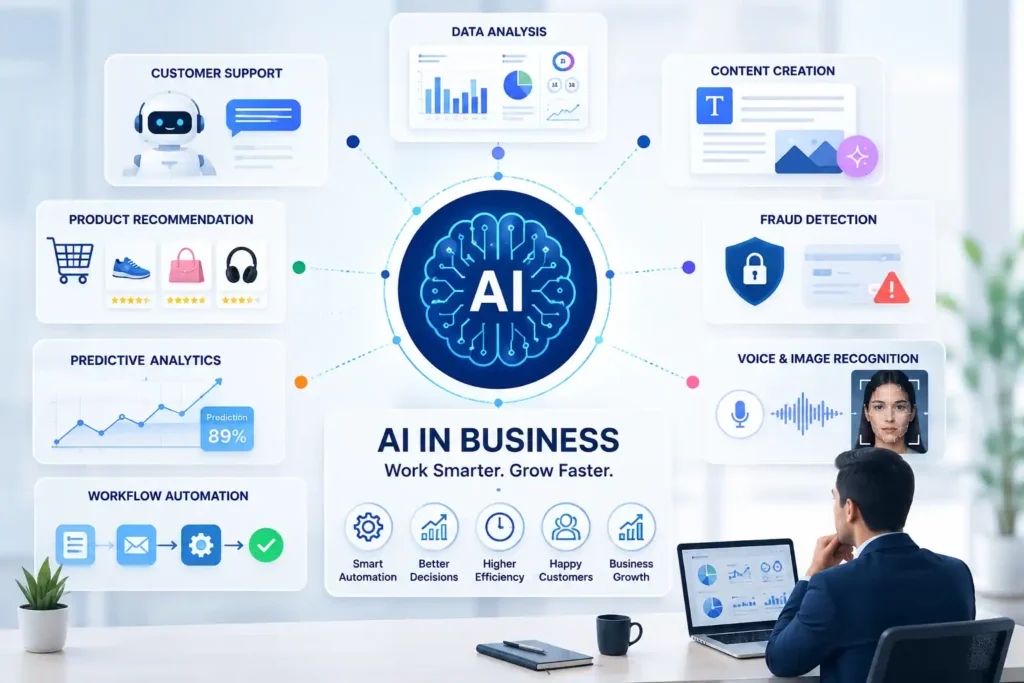
AI is not just one tool. It includes many technologies, such as machine learning, generative AI, natural language processing, predictive analytics, computer vision, and robotic process automation. Some AI tools create content, while others analyze data or automate business processes.
However, AI should not replace business judgment. It should support it. A business still needs human creativity, planning, emotional intelligence, leadership, and ethics. AI can suggest what to do, but humans must decide whether that suggestion is accurate, useful, and safe.
Why Businesses Are Using AI More Than Ever
Businesses are using AI because competition is faster than ever. A customer who sends a message today does not want to wait two days for a reply. A website visitor expects helpful product suggestions. A manager wants reports quickly instead of spending hours reviewing spreadsheets. AI automation helps businesses meet these expectations without increasing workload at the same rate.
Cost pressure is another major reason. Companies want to reduce manual work, avoid errors, and improve efficiency. AI can automate tasks like data entry, invoice processing, report summaries, appointment reminders, lead scoring, customer FAQs, and email drafts. This allows employees to spend more time on work that needs human thinking.
AI skills are also becoming more valuable in the job market. PwC’s 2025 Global AI Jobs Barometer found that workers with AI skills command a 56% wage premium, up from 25% the previous year. This shows that AI knowledge is not just useful for companies; it is becoming important for career growth as well.
Major Benefits of AI in Business
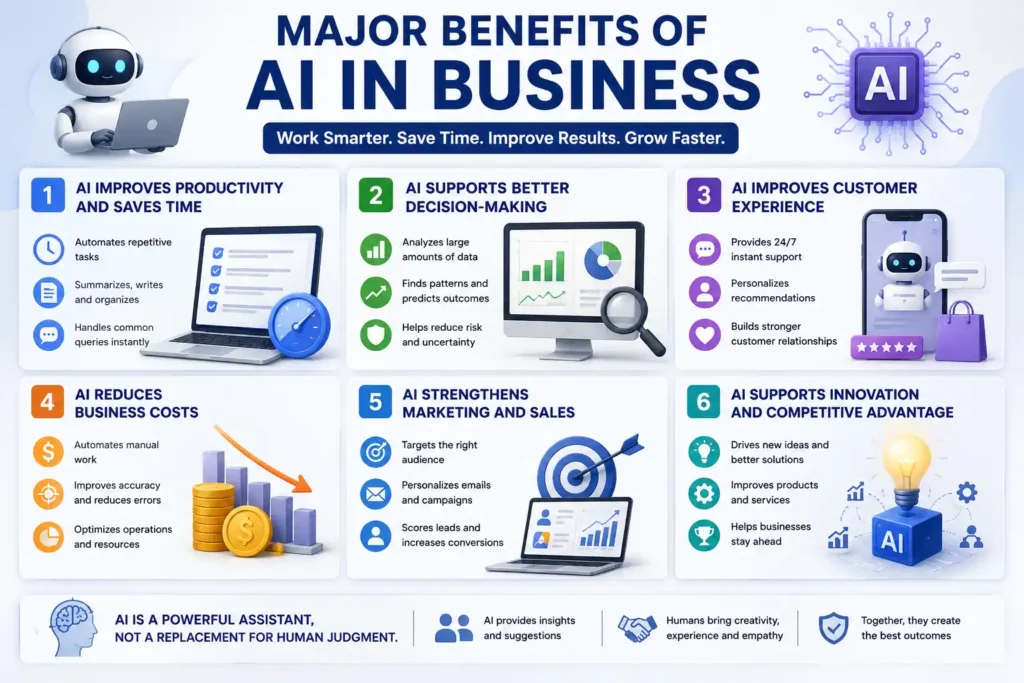
1. AI Improves Productivity and Saves Time
One of the biggest benefits of AI in business is improved productivity. AI can complete repetitive tasks much faster than humans. It can summarize documents, write drafts, organize data, prepare reports, answer common questions, and process information within seconds. For example, a customer support team may receive hundreds of similar questions about delivery, refunds, pricing, or account issues. Instead of making employees answer the same questions again and again, an AI chatbot can handle basic queries instantly. Human agents can then focus on complex problems that require empathy, negotiation, or deeper understanding.
AI also helps professionals manage information overload. A manager can use AI to summarize a long report. A marketer can generate campaign ideas faster. A developer can use AI coding tools to find errors. A business owner can use AI to draft emails, proposals, and product descriptions. AI does not remove the need for skill; it helps people use their time better.
2. AI Supports Better Decision-Making
Good business decisions depend on good information. AI can analyze large amounts of data and find patterns that humans may miss. This is useful for sales forecasting, inventory planning, pricing, customer segmentation, financial analysis, and risk management.
For example, an online store can use AI to predict which products may sell more during a specific season. A restaurant can analyze customer orders to decide which items should stay on the menu. A logistics company can use AI to improve delivery routes. A bank can use AI to detect fraud by identifying unusual transaction patterns.
However, AI decision-making works best when humans stay involved. AI can process data quickly, but it does not always understand real-world context. A forecast may not know about local events, supplier delays, customer emotions, or sudden market changes. The best business decisions come from combining AI insights with human experience.
3. AI Improves Customer Experience
Customer experience is one of the strongest areas where AI tools for business create value. Today’s customers want fast, helpful, and personalized service. AI helps businesses provide instant replies, better recommendations, and smoother support.
AI chatbots can answer customer questions 24/7. Recommendation systems can suggest products based on browsing history and buying behavior. Email marketing tools can send personalized messages at the right time. CRM systems can help sales teams understand what each customer needs.
When customers feel understood, they are more likely to buy, return, and recommend the business to others. But AI must be used carefully. If a chatbot gives wrong answers or blocks customers from reaching a human agent, the experience can become frustrating. The best customer service uses AI for speed and humans for care.
4. AI Reduces Business Costs
AI can reduce business costs by automating manual work, improving accuracy, and making operations more efficient. Many businesses spend too much time and money on repetitive tasks, delays, errors, and basic support work. AI can reduce this pressure.
For example, AI can lower customer support costs by answering common questions automatically. It can reduce marketing costs by improving ad targeting. It can reduce inventory waste by predicting demand. It can help finance teams process invoices and detect errors faster.
Still, cost saving should not be the only reason to use AI. A cheap AI system that gives poor answers can damage customer trust. Bad automation can create more confusion than savings. Businesses should measure AI success through productivity, quality, customer satisfaction, and long-term value.
5. AI Strengthens Marketing and Sales
AI marketing tools are popular because they help businesses reach the right people with the right message. AI can support keyword research, content writing, ad optimization, email personalization, audience segmentation, competitor analysis, and social media planning.
For sales teams, AI can score leads, predict buying intent, and suggest follow-up actions. Instead of treating every lead the same way, sales teams can focus on customers who are more likely to buy. This improves conversion rates and saves time.
However, businesses should avoid publishing generic AI content. Readers and search engines prefer helpful, original, human-written content that solves real problems. AI can help with research, structure, and ideas, but human creativity is needed to make content trustworthy and engaging.
6. AI Supports Innovation and Competitive Advantage
AI helps businesses create new products, improve services, and build better processes. A healthcare business can use AI to improve appointment scheduling. A real estate company can use AI to match buyers with properties. A software company can add AI features to its product. A manufacturing business can use AI for quality control.
This is why AI business strategy is becoming important. Businesses that learn how to use AI early can build better systems, stronger teams, and more useful customer experiences. But success does not come from simply buying AI tools. It comes from connecting AI with real business goals.
Main Risks of AI in Business
1. Data Privacy and Security Problems
The biggest risk of AI in business is data privacy. Many AI tools need data to work properly. This data may include customer details, employee records, financial documents, business plans, contracts, emails, or product information. If this information is entered into unsafe tools, it may be exposed or misused.
This is dangerous because customers trust businesses with their personal information. If a company leaks data through careless AI use, it can lose reputation, face legal trouble, and damage customer confidence. Even small businesses must be careful with private data.
Businesses should create clear AI policies. Employees should know which tools are approved, what type of data can be used, and what information must never be shared with public AI tools. NIST’s AI Risk Management Framework encourages organizations to manage AI risks through structured governance and controls.
2. AI Can Give Wrong Information
This is one of the biggest problems with generative AI. It may create false facts, outdated information, weak advice, or misleading summaries. These errors are often called hallucinations.
For example, an AI tool may write a product claim that is not true. It may summarize a contract incorrectly. It may suggest a poor financial decision. If a business publishes or acts on this information without checking, it can create serious problems.
The solution is simple: always review AI output. AI should be treated like a fast assistant, not a final authority. Businesses should verify facts, check sources, and involve experts when the work is sensitive.
3. Bias and Unfair Results
AI systems can produce biased results if they are trained on biased or incomplete data. This can affect hiring, lending, pricing, customer service, and decision-making. For example, if an AI hiring system learns from old data that favored certain candidates, it may repeat the same unfair pattern.
Bias is not always easy to see. AI should not be used blindly for important decisions.
A fair AI system needs good data, regular testing, human review, and clear accountability. Businesses should always ask: Is this AI treating people fairly? Can we explain the result? Who is responsible if something goes wrong?
4. Job Disruption and Skill Gaps
Many employees worry that AI will replace their jobs. This fear is understandable because AI can automate tasks that people used to do manually. Customer support, writing, data entry, admin work, analysis, and design are already being affected.
But AI does not only remove work; it also changes work. Employees who learn AI skills can become more productive and valuable. Businesses should train workers instead of simply replacing them. When employees understand AI, they are more likely to use it with confidence.
The smartest companies will not treat AI as a threat to employees. They will use it as a tool to upgrade the workforce. Training, communication, and support are essential for successful AI adoption.
5. Legal and Copyright Issues
AI can create legal problems if businesses do not understand how AI-generated content and data are handled. A company may use AI to create blogs, images, logos, videos, or code without knowing whether the output is safe for commercial use.
Legal risk is especially important in industries like healthcare, finance, insurance, education, recruitment, and law. If AI affects a customer, employee, or applicant, the business may need to explain how the decision was made. Saying “the AI decided” is not enough.
Businesses should check vendor terms, copyright rules, data policies, and compliance requirements before using AI for important work. Human accountability must remain part of the process.
AI Benefits vs AI Risks
| Area | Benefit of AI | Risk of AI |
| Productivity | Saves time and automates repetitive work | Poor automation can speed up mistakes |
| Customer Support | Gives quick 24/7 responses | Wrong chatbot answers can upset customers |
| Marketing | Improves targeting and personalization | Generic content can hurt brand trust |
| Data Analysis | Supports better decisions | Bad data can create misleading results |
| Cost Control | Reduces manual workload | Tools may be costly without clear ROI |
| Workforce | Helps employees work smarter | Some roles may change or disappear |
| Innovation | Creates new products and services | Poor planning can waste money |
Useful AI Tools for Business
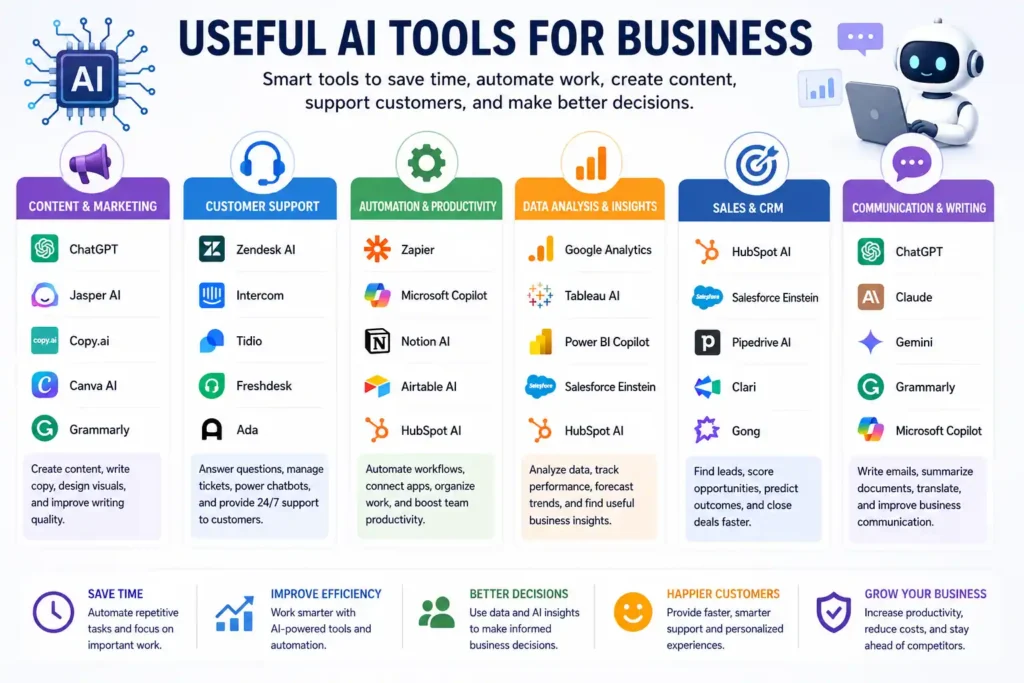
Businesses can use AI tools like ChatGPT, Claude, Gemini, Jasper AI, Canva AI, Grammarly, Zendesk AI, Intercom, Tidio, Zapier, Microsoft Copilot, HubSpot AI, Power BI Copilot, and Salesforce Einstein to save time, improve customer support, create content, automate workflows, and make better decisions. These tools can help with marketing, data analysis, sales, emails, reports, chatbots, and daily business tasks. However, companies should choose tools based on real business needs and always review AI outputs with human judgment.
How Businesses Can Use AI Safely
Using AI safely starts with a clear goal. A business should not adopt AI just because it is trending. It should first decide what problem AI will solve. Do you want faster customer support, better marketing, lower admin work, stronger reporting, or improved sales?
Businesses should also create an AI policy. This policy should explain which tools employees can use, what data is allowed, who reviews AI outputs, and which tasks require human approval. Even a simple policy can prevent major mistakes.
Human review is also important. AI-generated content should be checked before publishing. AI-based decisions should be reviewed before affecting customers or employees. AI reports should be verified before being used in business strategy.
Employee training is another key step. Workers need to learn prompt writing, fact-checking, data privacy, ethical AI use, and tool-specific workflows. The better employees understand AI, the more value the business can get from it.
Future of AI in Business
The future of AI in business will be more advanced and more connected to daily workflows. Businesses will not only use AI to write content or answer questions. They will use AI agents that can complete multi-step tasks, update records, connect software, analyze performance, and support decision-making.
AI will also become more industry-specific. Instead of general tools, businesses will use AI systems designed for healthcare, finance, retail, education, manufacturing, real estate, and law. These tools will understand industry language and workflows better.
The companies that succeed with AI will be those that combine technology with strategy. They will train employees, protect data, measure results, improve workflows, and keep humans involved. AI will not replace good business thinking. It will reward businesses that know how to use it responsibly.
FAQs
1. What are the main benefits of AI in business?
The main benefits include better productivity, lower costs, faster customer support, smarter decision-making, improved marketing, and personalized customer experiences.
2. What are the biggest risks of AI in business?
The biggest risks include data privacy issues, security threats, wrong information, bias, legal problems, copyright concerns, and job disruption.
3. Can AI replace employees?
AI can replace some repetitive tasks, but it cannot fully replace human creativity, judgment, empathy, leadership, and responsibility. Many jobs will change rather than disappear completely.
4. How can small businesses use AI?
Small businesses can use AI for customer support, content writing, email marketing, social media planning, product descriptions, scheduling, and basic data analysis.
5. Is AI safe for business?
AI can be safe when businesses use secure tools, clear policies, employee training, human review, and proper data protection. Unsafe AI use usually happens when companies ignore privacy, accuracy, or legal risks.