
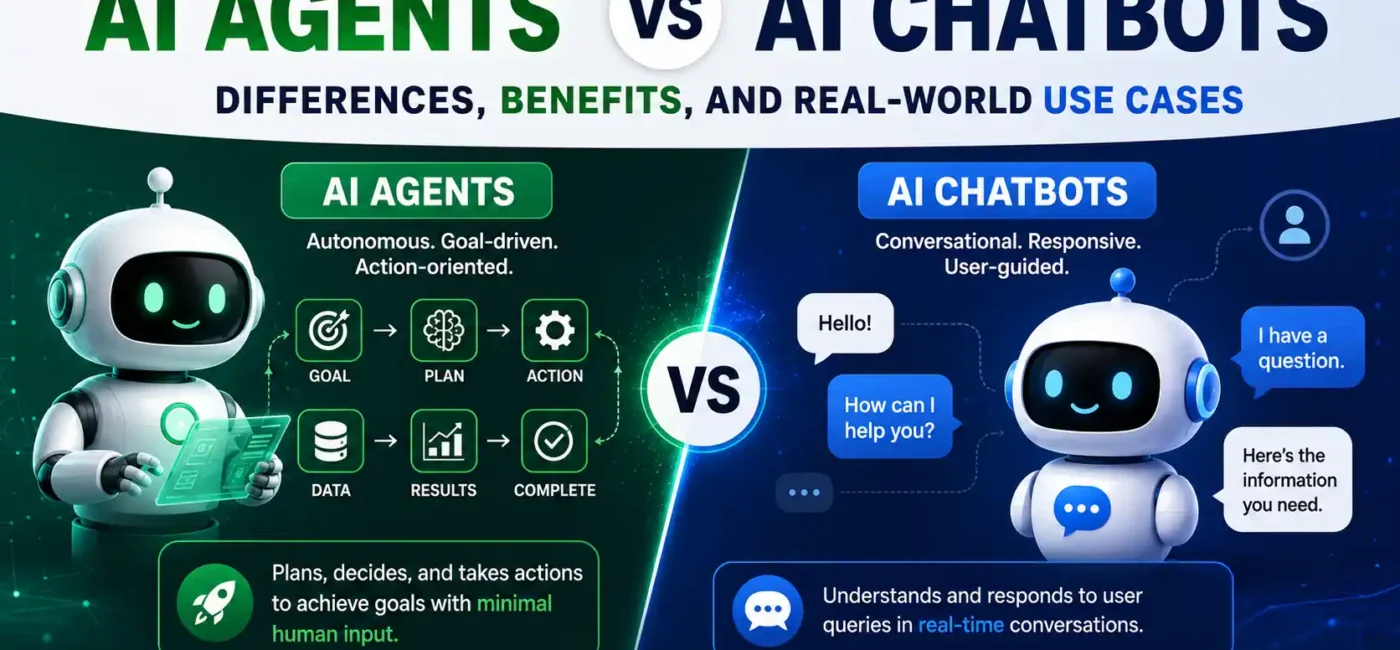
Artificial intelligence is changing the way people communicate with technology. Two terms you will often hear are AI agents and AI chatbots. While they may seem similar, they are designed for different purposes.
An AI chatbot mainly communicates with users and responds to questions. Popular examples include customer support bots and tools such as ChatGPT. You can also explore our guide to AI tools for productivity to see how different AI systems are used in everyday work.
An AI agent can go further by making decisions, using tools, completing tasks, and working toward a specific goal with less human involvement. For example, AI agents can support research, scheduling, data analysis, and business automation.
Understanding the difference between AI agents and AI chatbots can help individuals and businesses choose the right technology for customer service, productivity, automation, research, sales, and many other tasks.
What Is an AI Chatbot?
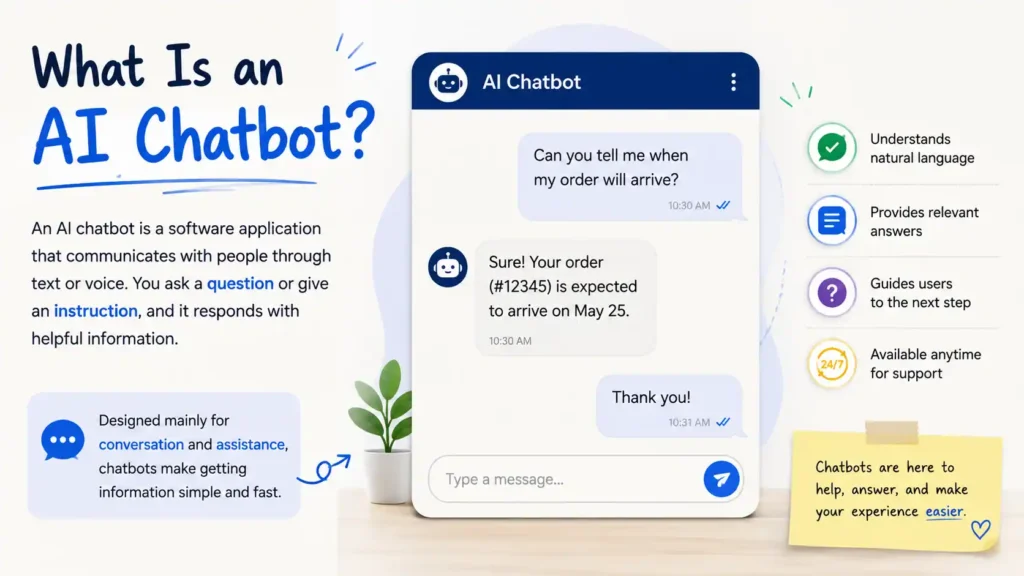
An AI chatbot is a software application designed to communicate with people through text or voice. Users ask questions or provide instructions, and the chatbot generates a relevant response.
Traditional chatbots often follow predefined rules. For example, a customer service chatbot may present users with options such as:
- Track my order
- Change my password
- Contact customer support
- View pricing information
Modern AI chatbots are more advanced. They can use natural language processing and large language models to understand everyday language and provide more flexible answers.
Instead of requiring users to select a specific option, an AI chatbot may understand a question such as:
“Can you tell me when my order will arrive?”
The chatbot can then provide the appropriate information or guide the user to the next step.
However, most chatbots are still primarily designed for conversation and assistance rather than independent task completion.
What Is an AI Agent?
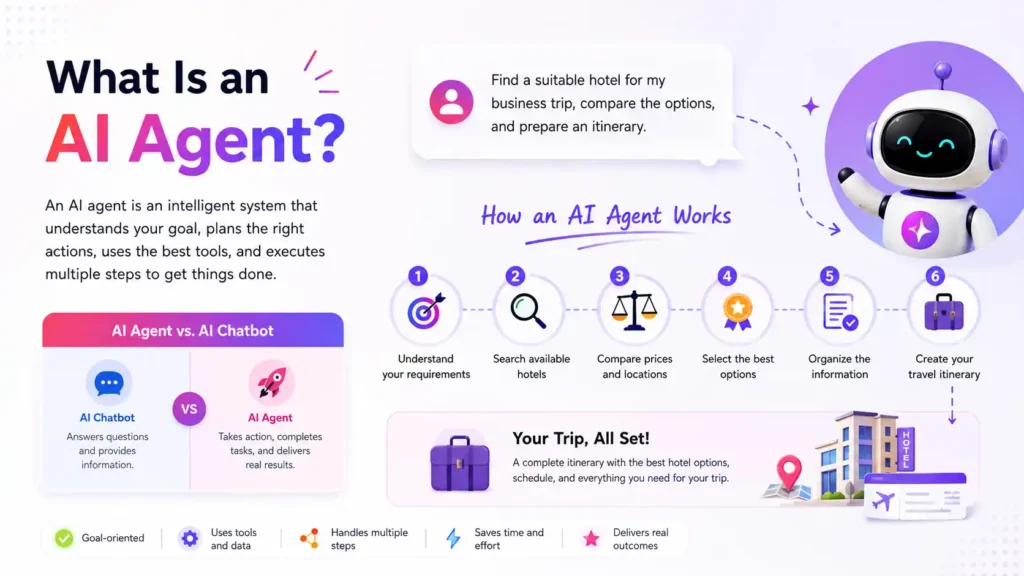
An AI agent is an AI-powered system that can understand a goal, determine the required actions, use available tools, and execute multiple steps to complete a task.
For example, imagine asking an AI system:
“Find a suitable hotel for my business trip, compare the options, and prepare an itinerary.”
A standard chatbot may explain how to search for hotels or recommend a few options.
An AI agent could potentially perform several connected actions, such as:
- Understanding your travel requirements
- Searching available hotels
- Comparing prices and locations
- Selecting suitable options
- Organizing the information
- Creating a travel itinerary
This ability to move from conversation to action is one of the biggest differences between AI agents and AI chatbots.
AI Agents vs AI Chatbots: What Is the Main Difference?
The simplest way to understand the difference is this:
AI chatbots are mainly designed to communicate, while AI agents are designed to work toward goals and take actions.
A chatbot usually waits for the user to send another message before continuing.
An AI agent may be able to determine the next step itself based on the goal it has been given.
Here is a simple comparison:
| Feature | AI Chatbots | AI Agents |
|---|---|---|
| Main purpose | Conversation and assistance | Completing goals and tasks |
| User interaction | Usually requires continuous prompts | Can perform several steps independently |
| Decision-making | Limited or prompt-based | More autonomous |
| Tool usage | May use connected tools | Often designed to use multiple tools |
| Task complexity | Simple to moderate | Moderate to complex |
| Workflow automation | Limited | Strong |
| Best suited for | FAQs, support and information | Automation, research and multi-step tasks |
How Do AI Chatbots Work?
AI chatbots receive a user’s message, analyze its meaning, and generate an appropriate response.
Depending on the chatbot, the response may come from:
- Predefined rules
- A knowledge base
- Company documents
- Artificial intelligence models
- Connected databases
- External tools or APIs
For example, a banking chatbot may answer questions about account services, while an e-commerce chatbot may help users understand delivery policies.
Advanced AI chatbots can also maintain conversational context. This allows users to ask follow-up questions without having to repeat everything from the beginning. Even with these improvements, the chatbot’s main role usually remains responding to the user.
How Do AI Agents Work?
AI agents typically work through a more action-oriented process.
First, the agent receives a goal. It then evaluates what needs to happen to achieve that goal.
A basic AI agent workflow may look like this:
Goal → Plan → Action → Result → Evaluation → Next Action
Suppose someone asks an AI agent to research five competitors.
The agent may:
- Search for competitor information
- Visit relevant sources
- Collect useful data
- Compare products or services
- Identify important differences
- Organize the findings
- Produce a final report
If the agent has access to the required tools and permissions, it may complete much of this workflow without requiring the user to manually request every individual step.
Key Differences Between AI Agents and AI Chatbots
1. AI Chatbots Focus on Conversation
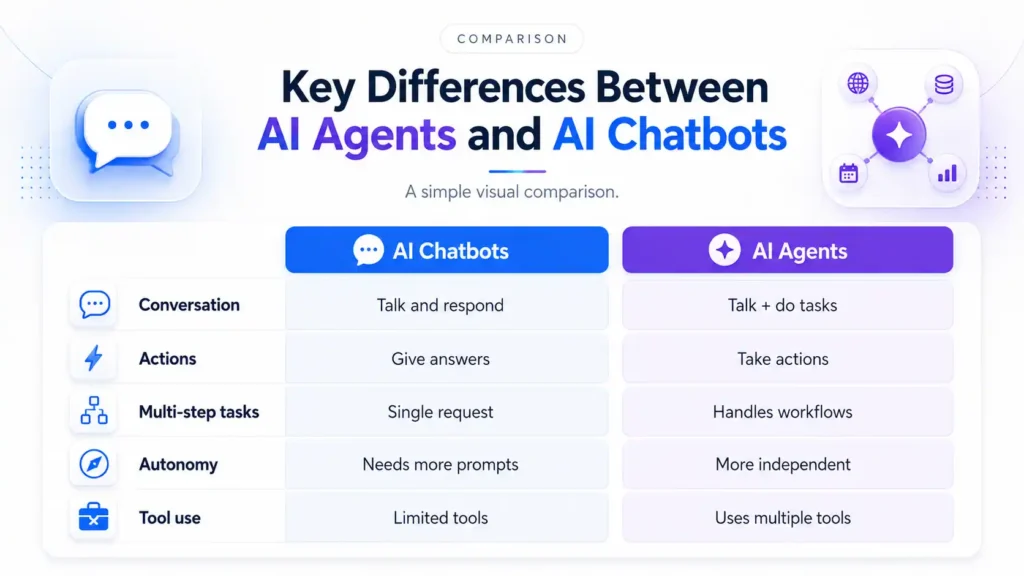
The primary job of a chatbot is to communicate with users. It may answer questions, explain information, provide recommendations, or guide people through a process. AI agents can communicate too, but conversation is usually only one part of what they do.
2. AI Agents Can Take Actions
An AI agent may interact with external systems or tools to complete tasks. Depending on its setup, an agent could search databases, analyze information, create files, update records, schedule activities, or trigger workflows. This makes AI agents useful for automation.
3. AI Agents Can Handle Multi-Step Tasks
A chatbot often deals with one request at a time. An agent may break a larger goal into smaller tasks and complete them in sequence. For example, instead of simply explaining how to prepare a weekly report, an AI agent could gather the required information, organize the data, create the report, and deliver the final result.
4. AI Agents Have Greater Autonomy
Autonomy refers to how much a system can do without constant human direction. Chatbots generally depend heavily on user prompts. AI agents can have greater autonomy because they may determine which action should happen next. The level of autonomy varies considerably, however. Businesses can place limits on what an agent is allowed to access or change.
5. AI Agents Often Use Multiple Tools
An AI agent becomes particularly useful when connected to other systems.
For example, an agent may interact with:
- Email platforms
- Calendars
- Databases
- Search tools
- Customer relationship management systems
- Business applications
Instead of simply telling the user what to do, the agent may use these tools to help complete the work.
Benefits of AI Chatbots
AI chatbots remain extremely useful, particularly when the main goal is communication.
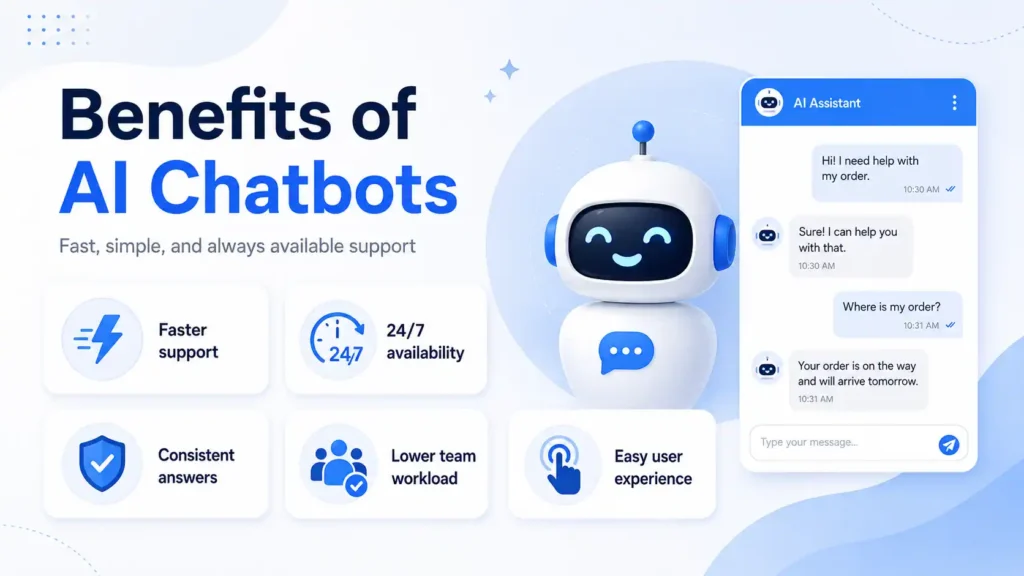
Faster Customer Support
Chatbots can answer common questions immediately without requiring customers to wait for a human representative.
They can help with basic questions about pricing, products, orders, policies, and account information.
24/7 Availability
Businesses can make chatbots available around the clock.
This is especially helpful for companies with customers in different countries and time zones.
Consistent Responses
A properly configured chatbot can provide consistent information to different users.
This reduces the chance of customers receiving completely different answers to the same basic question.
Lower Workload for Teams
Chatbots can handle repetitive questions, allowing employees to spend more time on situations that require judgment, creativity, or personal attention.
Easy User Experience
Users do not always want to search through a long website or knowledge base.
A chatbot provides a simpler experience: ask a question and receive an answer.
Benefits of AI Agents
AI agents provide additional advantages when tasks involve several steps or systems.
Greater Automation
AI agents can automate workflows rather than simply answering questions. For example, an agent may collect information, process it, and trigger another action automatically.
Improved Productivity
Routine administrative work can consume significant employee time. Agents can assist with repetitive activities such as organizing information, generating reports, checking records, and coordinating workflows.
Multi-Step Problem Solving
AI agents can approach a goal as a sequence of connected tasks. This makes them useful for more complicated activities than traditional chatbots.
Better Use of Business Tools
When properly integrated, an AI agent can connect different tools that employees already use. For example, information could move between email, calendars, databases, and project management systems with less manual effort.
More Personalized Workflows
An AI agent can potentially use available context to adapt its actions to a particular user, customer, project, or business process.
Real-World Use Cases of AI Chatbots
AI chatbots are already useful across many industries.
Customer Service
Businesses use chatbots to answer FAQs, explain policies, assist with orders, and direct customers to the right support team.
E-Commerce
Online stores can use chatbots to help shoppers find products, check delivery information, understand return policies, and receive basic recommendations.
Education
Students can interact with AI chatbots to understand concepts, practice questions, summarize topics, or receive explanations.
Healthcare Administration
Chatbots can help with general administrative tasks such as appointment guidance, service information, and basic patient navigation. They should not replace qualified healthcare professionals for important medical decisions.
Banking and Financial Services
Financial institutions may use chatbots to answer common questions about accounts, cards, services, and procedures.
Real-World Use Cases of AI Agents
AI agents are especially useful when work involves several connected actions.
Research
An AI agent can help collect information from multiple sources, organize findings, compare information, and create summaries. This can save time for researchers, marketers, students, and business teams.
Sales
Sales agents may help qualify leads, organize customer information, prepare follow-up messages, or update sales systems.
Marketing
An AI agent could assist with keyword research, competitor monitoring, content planning, performance analysis, and campaign reporting.
Software Development
AI-powered coding agents can assist developers with tasks such as reviewing code, identifying problems, generating tests, and working through development tasks.
Business Operations
Agents can support routine workflows involving documents, reports, schedules, databases, and internal systems.
Personal Productivity
Individuals may eventually rely more heavily on AI agents for activities such as scheduling, organizing information, planning trips, managing tasks, and coordinating everyday digital work.
AI Agent vs Chatbot Example
Imagine you want to arrange a meeting with a client.
You ask a chatbot:
“How can I schedule a meeting with my client next week?”
The chatbot might suggest checking your calendar, finding an available time, and sending an invitation.
Now imagine giving an AI agent the same goal.
With the appropriate permissions, the agent could potentially:
- Check your calendar
- Find available time slots
- Compare them with the client’s availability
- Select an appropriate time
- Create the calendar event
- Send the invitation
The chatbot explains the process. The agent may carry out the process. That is the practical difference.
Are AI Agents Better Than AI Chatbots?
Not necessarily. AI agents are more capable in certain situations, but that does not mean every business needs one. A simple chatbot may be the better option when users mainly need quick answers.
For example, a small website that receives repetitive questions about opening hours, pricing, or delivery may not require a complex AI agent.
AI agents become more valuable when the system needs to:
- Complete several connected tasks
- Make decisions based on changing information
- Interact with multiple tools
- Automate repetitive workflows
- Work toward a defined outcome
The best option depends on the problem you are trying to solve.
When Should You Use an AI Chatbot?
Choose an AI chatbot when your main goal is:
- Answering customer questions
- Providing basic support
- Helping users navigate a website
- Delivering information quickly
- Creating a conversational interface
- Handling common FAQs
Chatbots are generally a practical starting point when communication is more important than automation.
When Should You Use an AI Agent?
Consider an AI agent when you need:
- Multi-step workflow automation
- Independent task execution
- Research across different sources
- Integration with several business tools
- Repetitive operational tasks to be automated
- A system that can work toward a specific goal
Businesses should still maintain appropriate human oversight, especially when an AI system handles sensitive information or important decisions.
AI Agents and Chatbots Can Work Together
AI agents and chatbots do not have to compete. In many applications, the chatbot can act as the user interface, while an AI agent works behind the scenes.
For example, a customer might tell a chatbot:
“I need to change my delivery date.”
The conversational AI can understand the request while an AI agent checks the order, reviews available delivery dates, updates the system, and confirms the change. Combining conversation with automation can create a much more useful AI experience.
The Future of AI Agents and AI Chatbots
The line between chatbots and AI agents is becoming less obvious. Chatbots are gaining access to more tools, while AI agents are becoming easier to interact with through natural conversation. As these technologies improve, users may increasingly expect AI systems not only to answer questions but also to help complete tasks. However, greater capability also creates greater responsibility. Businesses need clear rules around privacy, security, permissions, accuracy, and human oversight. The most successful AI systems will not simply be the most autonomous. They will be the ones that provide useful automation while giving users appropriate control.
Frequently Asked Questions
Q1. What is the main difference between AI agents and AI chatbots?
AI chatbots primarily communicate with users and respond to questions. AI agents can go beyond conversation by planning steps, using tools, making certain decisions, and performing actions to achieve a goal.
Q2. Is ChatGPT an AI chatbot or an AI agent?
The answer depends on how an AI system is configured. A conversational AI application can behave primarily as a chatbot, while systems that provide access to tools and task-execution capabilities can support more agent-like workflows.
Q3. Can AI agents work without humans?
AI agents can perform some tasks with limited human involvement, but the amount of independence depends on their design and permissions. Human supervision remains important for sensitive, high-impact, or complex decisions.
Q4. Will AI agents replace chatbots?
AI agents are unlikely to make chatbots unnecessary. Instead, the two technologies can work together. A chatbot can provide the conversational interface while an agent performs actions behind the scenes.
Q5. Which is better for businesses: AI agents or AI chatbots?
It depends on the business need. Chatbots are useful for customer communication and FAQs, while AI agents are better suited to multi-step automation and workflows involving several tools or systems.