
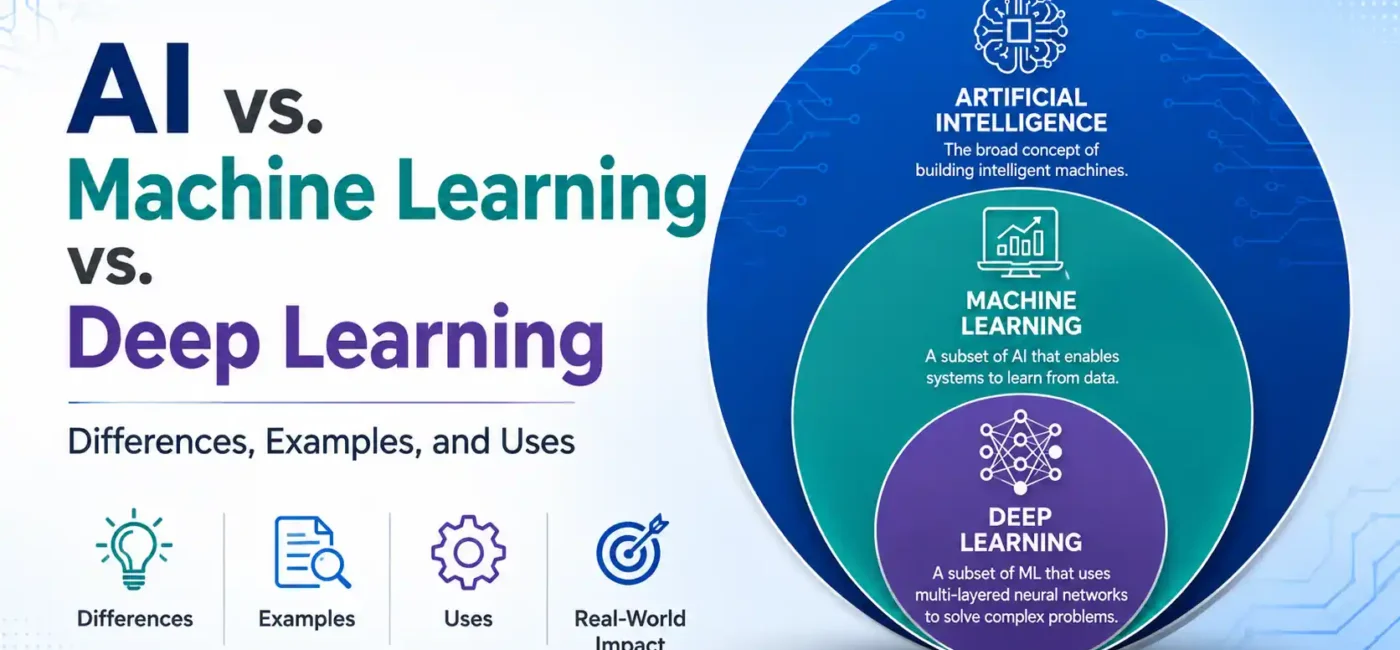
Artificial intelligence, machine learning, and deep learning are three important technologies that students often hear about in computer science, data science, robotics, and modern software development. These terms are commonly used when discussing chatbots, recommendation systems, self-driving cars, image recognition, automation, and generative AI tools.
Although they are related, they are not the same.
Artificial Intelligence (AI) is a branch of computer science that develops smart computer programs and systems capable of performing tasks that usually require human intelligence, such as recognizing images, understanding language, solving problems, and making decisions.
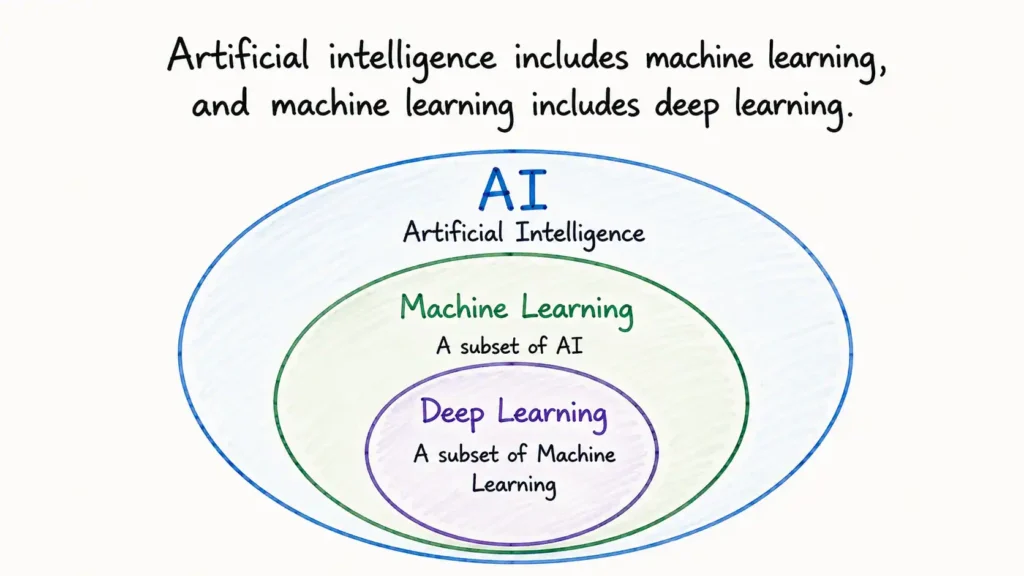
The simplest way to understand their relationship is:
Artificial intelligence includes machine learning, and machine learning includes deep learning.
In other words:
AI → Machine Learning → Deep Learning
This guide explains the differences between AI, machine learning, and deep learning, how each technology works, where it is used, and which approach is best for different types of projects.
What Is Artificial Intelligence?
Artificial intelligence, commonly known as AI, is the broad field of creating computer systems capable of performing tasks that usually require human intelligence.
These tasks can include:
- Understanding language
- Recognizing objects
- Solving problems
- Making decisions
- Planning actions
- Generating content
- Learning from experience
- Interpreting visual information
Some of the most popular AI-powered applications include ChatGPT, Google Gemini, Microsoft Copilot, Claude, and GitHub Copilot.
Google Cloud describes artificial intelligence as a broad area of technology that includes systems designed to perform tasks associated with human intelligence. Machine learning is one of the methods used to create those intelligent capabilities.
AI does not always require a system to learn from data. Some artificial intelligence systems operate through predefined rules, logic, decision trees, or expert knowledge programmed by humans.
For example, an early chess program could evaluate possible moves using rules created by developers. It might behave intelligently without learning from previous games.
Examples of Artificial Intelligence
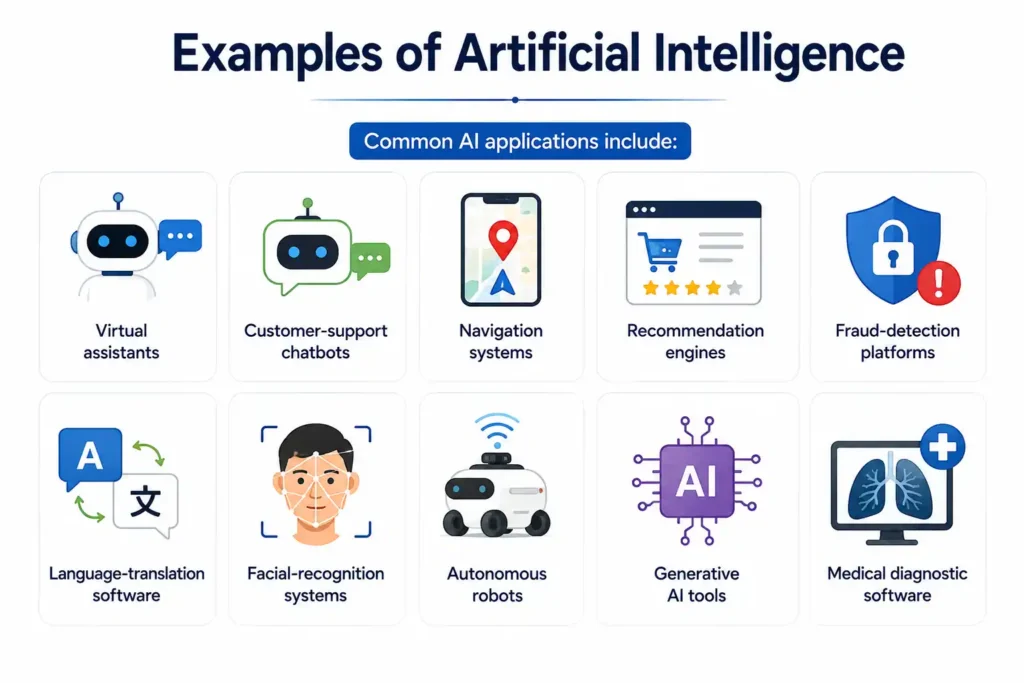
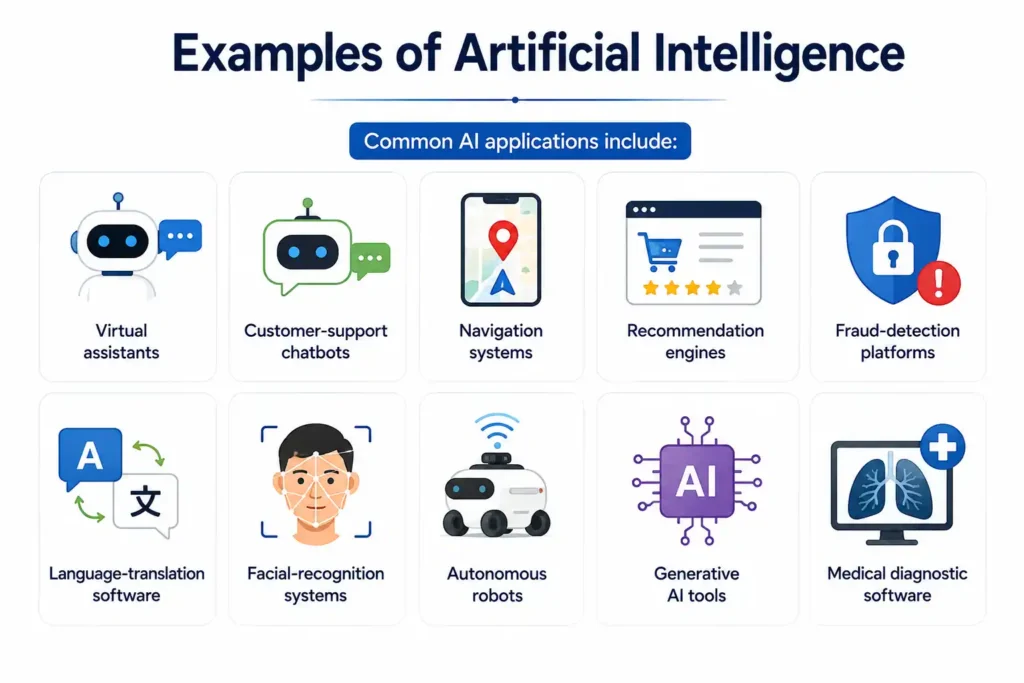
Common AI applications include:
- Virtual assistants
- Customer-support chatbots
- Navigation systems
- Recommendation engines
- Fraud-detection platforms
- Language-translation software
- Facial-recognition systems
- Autonomous robots
- Generative AI tools
- Medical diagnostic software
AI is the umbrella category under which machine learning, deep learning, natural language processing, computer vision, robotics, and expert systems exist.
How Does Artificial Intelligence Work?
AI systems use different techniques depending on the problem they are designed to solve.
A rule-based AI system follows instructions created by developers. A machine-learning system studies data and discovers patterns. A deep-learning system processes information through multiple layers of artificial neural networks.
An AI system may involve several components:
- Data collection: The system receives information from databases, sensors, user interactions, images, documents, or online sources.
- Data processing: The information is cleaned, organized, and transformed into a usable format.
- Algorithm selection: Developers choose a method that fits the task.
- Training or programming: The system either learns from examples or follows predefined instructions.
- Prediction or decision-making: The AI produces an answer, classification, recommendation, or action.
- Evaluation: Developers check whether the system is accurate, reliable, and useful.
- Improvement: The model, rules, or training data may be updated to improve performance.
The exact process depends on whether the application uses traditional programming, machine learning, deep learning, or a combination of these technologies.
What Is Machine Learning?
Machine learning, or ML, is a subset of artificial intelligence that allows computer systems to learn patterns from data and improve their performance without requiring developers to manually program every possible rule.
Instead of telling the computer exactly how to solve every situation, developers provide data and an algorithm. The algorithm studies the data, identifies relationships, and builds a model that can make predictions about new information.
For example, developers could train a spam-detection system using thousands of emails labeled as “spam” or “not spam.” The machine-learning model would study characteristics such as wording, links, sender behavior, and message structure.
After training, it could estimate whether a new email is likely to be spam.
Machine learning is therefore not a completely separate technology from AI. It is one of the most important methods used to build AI systems.
How Does Machine Learning Work?
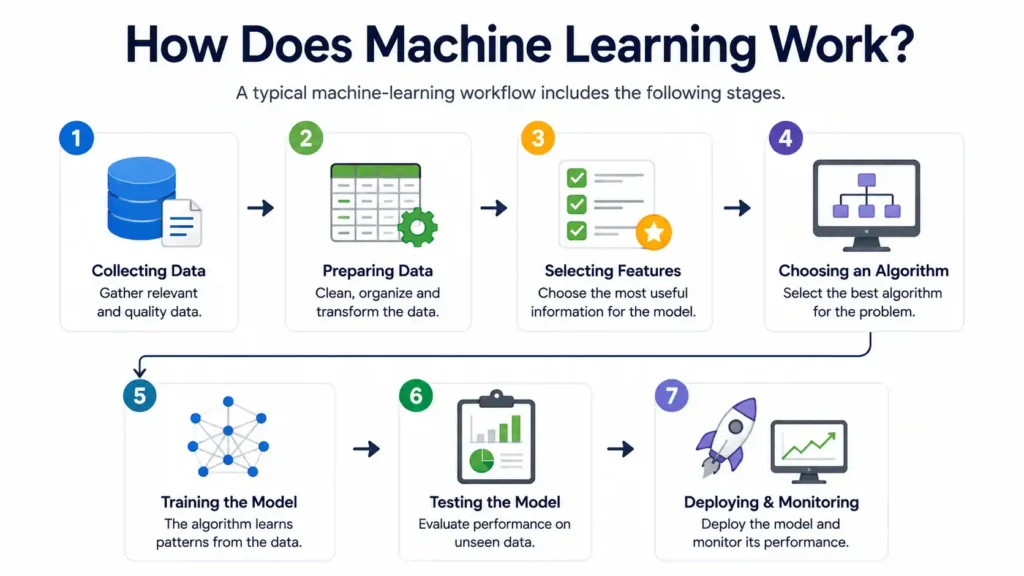
1. Collecting Data
The first step is gathering relevant data. The quality and relevance of this data strongly influence the model’s performance.
For a house-price prediction system, the data might include:
- Property size
- Number of bedrooms
- Location
- Building age
- Previous sale price
- Nearby facilities
2. Preparing the Data
Raw data often contains missing values, duplicates, incorrect labels, and inconsistent formats. Data preparation may involve cleaning, organizing, labeling, and transforming the information.
3. Selecting Features
Features are the pieces of information that a model uses to make predictions. In a house-price model, location and property size may be highly useful features. The color of the front door might be far less useful.
Traditional machine-learning projects often depend heavily on humans selecting appropriate features.
4. Choosing an Algorithm
Developers choose an algorithm based on the problem.
Common machine-learning algorithms include:
- Linear regression
- Logistic regression
- Decision trees
- Random forests
- Support vector machines
- K-nearest neighbors
- Naive Bayes
- Clustering algorithms
- Neural networks
5. Training the Model
During training, the algorithm studies the available data and adjusts its internal parameters to identify useful patterns.
6. Testing the Model
The trained model is tested on data it has not seen before. This helps determine whether it can make accurate predictions in real situations rather than simply memorizing the training examples.
7. Deploying and Monitoring
Once the model performs well, it can be integrated into an application. Its accuracy and behavior must still be monitored because user behavior, market conditions, and incoming data can change over time.
Main Types of Machine Learning
Machine learning is generally divided into several major categories.
Supervised Learning
Supervised learning uses labeled training data. Each training example includes an input and the correct output. For example, a model may receive images labeled as “cat” or “dog.” It learns the patterns that separate the two categories and then classifies new images. IBM defines supervised learning as a technique in which labeled datasets help models identify patterns and predict outputs for new data.
Common supervised-learning tasks include:
- Email spam detection
- Price prediction
- Credit-risk assessment
- Customer-churn prediction
- Medical diagnosis support
Unsupervised Learning
Unsupervised learning uses data without predefined labels. The system searches for hidden structures, groups, or relationships.
Common applications include:
- Customer segmentation
- Anomaly detection
- Product grouping
- Market-basket analysis
- Pattern discovery
For example, an online store could use unsupervised learning to group customers according to purchasing habits without defining those groups in advance.
Semi-Supervised Learning
Semi-supervised learning combines a small amount of labeled data with a larger amount of unlabeled data.
This can be useful when labeling information is expensive or time-consuming. Medical images are one example because expert professionals may be required to label each image accurately.
Reinforcement Learning
Reinforcement learning allows an agent to learn through interaction with an environment. The agent receives rewards for useful actions and penalties for poor actions. Over time, it learns a strategy that increases its total reward.
Reinforcement learning may be used in:
- Robotics
- Game-playing systems
- Resource optimization
- Autonomous navigation
- Industrial control systems
What Is Deep Learning?
Deep learning is a specialized branch of machine learning that uses artificial neural networks with multiple processing layers.
The word “deep” refers to the depth of the neural network. A deep-learning system may contain many hidden layers between its input and output.
These layers gradually learn increasingly complex features from data.
For example, when processing an image:
- An early layer may detect edges.
- Another layer may detect shapes.
- A deeper layer may recognize facial features.
- The final layers may identify a particular person or object.
Deep learning is particularly effective for processing large amounts of unstructured data, such as images, speech, video, and natural language.
Google Cloud and IBM both describe deep learning as a subset of machine learning based on multilayered artificial neural networks.
How Does Deep Learning Work?
Deep-learning models are built from artificial neural networks inspired loosely by the way biological neurons exchange signals.
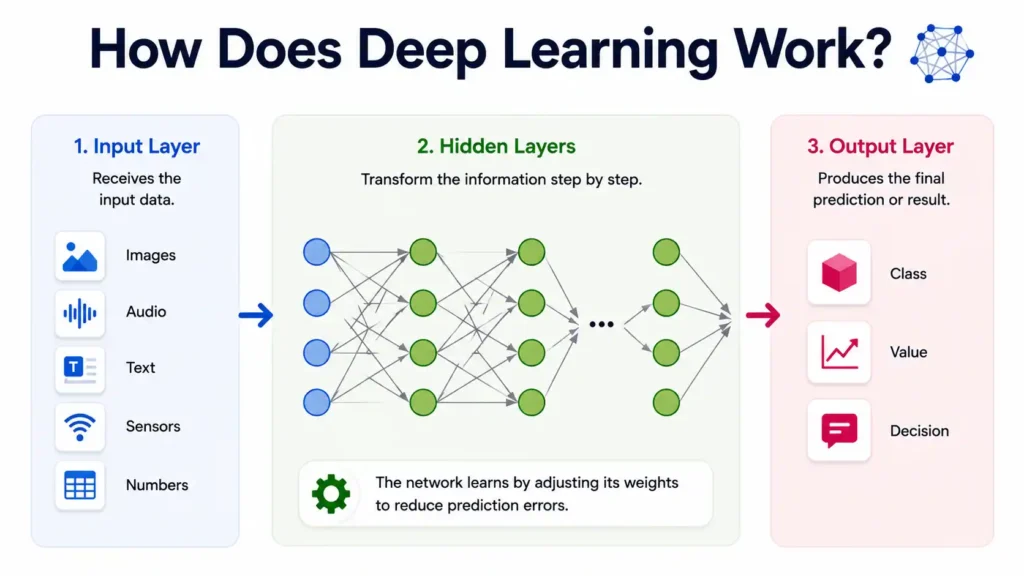
A neural network usually contains three main types of layers.
Input Layer
The input layer receives the original information.
This could include:
- Image pixels
- Audio signals
- Written words
- Sensor readings
- Numerical values
Hidden Layers
Hidden layers transform the information step by step. Each artificial neuron receives inputs, applies mathematical operations, and passes a result to the next layer. During training, the network adjusts its internal weights to reduce prediction errors. A deep neural network contains multiple hidden layers, allowing it to learn highly complex relationships.
Output Layer
The output layer produces the final prediction or result.
For example, the output may indicate:
- Which object appears in an image
- Which word comes next in a sentence
- Whether a transaction appears fraudulent
- What a customer is likely to purchase
- What response a chatbot should generate
AI vs Machine Learning vs Deep Learning: Quick Comparison
| Feature | Artificial Intelligence | Machine Learning | Deep Learning |
|---|---|---|---|
| Meaning | Broad field of creating intelligent systems | Subset of AI that learns from data | Subset of ML using deep neural networks |
| Scope | Broadest category | More specialized | Most specialized |
| Data requirement | Can work with rules or data | Usually requires structured training data | Often requires very large datasets |
| Human involvement | Varies by system | Often requires feature engineering | Can automatically learn many features |
| Computing power | Low to very high | Moderate to high | Usually high |
| Common data types | Rules structured data and unstructured data | Often structured or labeled data | Images text audio video and other complex data |
| Training time | Depends on the method | Usually moderate | Often lengthy |
| Interpretability | Can be highly explainable | Often easier to interpret | Frequently difficult to explain |
| Typical examples | Expert systems robots and intelligent assistants | Fraud detection recommendations and forecasting | Image recognition language models and speech recognition |
The Main Difference Between AI, Machine Learning, and Deep Learning
The key difference is their scope and the methods they use.
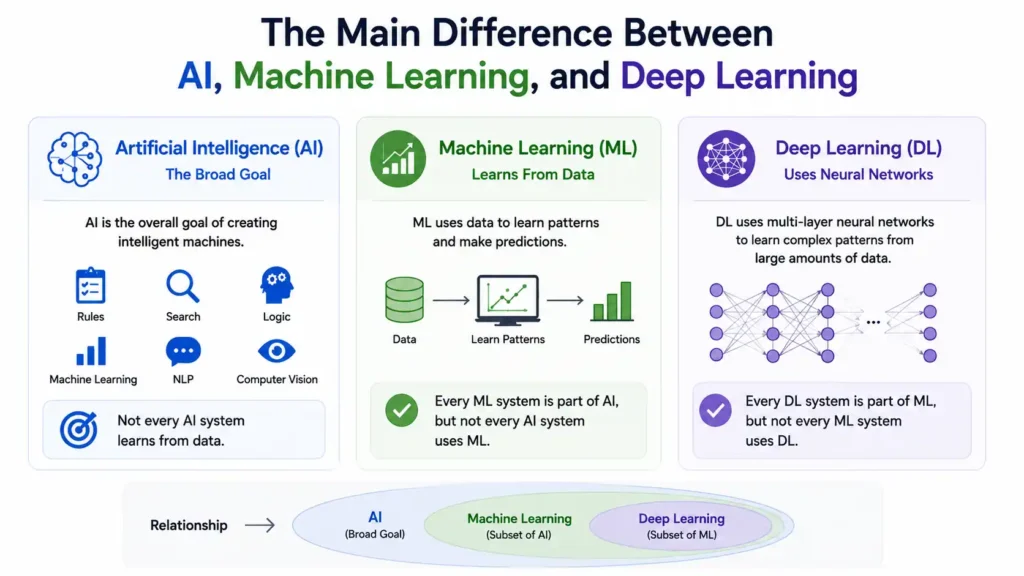
Artificial Intelligence Is the Broad Goal
AI refers to the overall goal of making machines perform intelligent tasks.
An AI system might use:
- Handwritten rules
- Search algorithms
- Logic
- Machine learning
- Deep learning
- Natural language processing
- Computer vision
Not every AI system learns from data.
Machine Learning Learns From Data
Machine learning is one way to achieve artificial intelligence. Instead of relying only on manually programmed rules, ML systems use historical information to identify patterns and make predictions.
Every machine-learning system can be considered part of AI, but not every AI system uses machine learning.
Deep Learning Uses Multilayered Neural Networks
Deep learning is a more specialized machine-learning approach. It is especially powerful when working with complex, high-volume, unstructured data. Deep-learning systems can automatically learn many relevant features that traditional ML projects may require humans to define manually. Every deep-learning system is a machine-learning system, but not every machine-learning system uses deep learning.
A Simple Example: Building an Email Spam Filter
Consider how the three approaches could be used to create a spam filter.
Rule-Based Artificial Intelligence
A developer might create rules such as:
- Mark the message as spam when it contains certain phrases.
- Block messages from known suspicious domains.
- Flag emails containing too many links.
- Flag messages written mostly in capital letters.
This is an AI-style decision system, but it may not learn automatically.
Machine Learning
A machine-learning model could analyze thousands of labeled emails and learn which characteristics are associated with spam.
It might examine:
- Sender history
- Word frequency
- Link patterns
- Message length
- User reports
- Subject-line structure
Deep Learning
A deep-learning model could process the full context and meaning of an email using a neural network.
It may identify more subtle patterns, including:
- Misleading language
- Contextual relationships
- Writing patterns
- Impersonation attempts
- Complex phishing messages
The deep-learning approach may provide stronger performance but usually requires more data, processing power, and technical resources.
Traditional Machine Learning vs Deep Learning
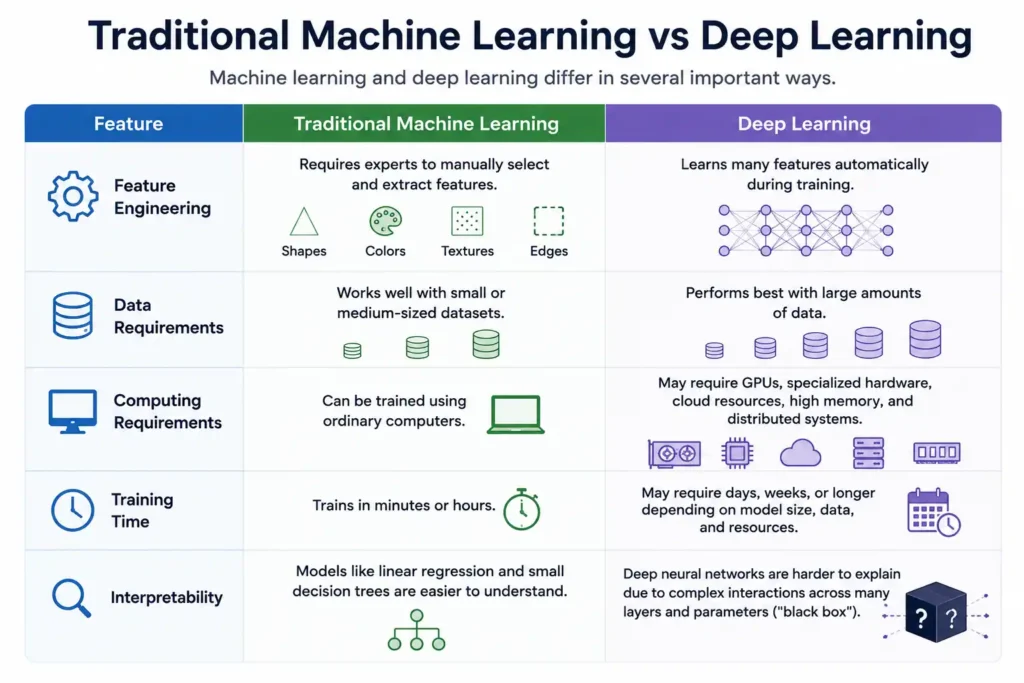
Machine learning and deep learning differ in several important ways.
Feature Engineering
Traditional machine learning often requires experts to decide which features the model should examine.
For an image-classification project, developers might manually extract information about:
- Shapes
- Colors
- Textures
- Edges
Deep-learning models can learn many of these features automatically during training.
Data Requirements
Traditional ML can work effectively with relatively small or medium-sized datasets. Deep learning often performs best with large amounts of data. Without sufficient high-quality training data, a complex neural network may not outperform a simpler algorithm.
Computing Requirements
Many traditional machine-learning models can be trained using ordinary computers.
Deep-learning models may require:
- Graphics processing units
- Specialized accelerators
- Cloud computing resources
- High-memory systems
- Distributed training infrastructure
Training Time
A traditional machine-learning model may be trained in minutes or hours.
A large deep-learning model may require days, weeks, or longer, depending on its size, data, and computing resources.
Interpretability
Traditional models such as linear regression and small decision trees are often relatively easy to understand.
Deep neural networks can be more difficult to explain because their predictions depend on complex interactions across many layers and parameters.
This difficulty is sometimes known as the “black box” problem.
Real-World Applications of Artificial Intelligence
Customer Support
Businesses use AI chatbots to answer common questions, route support requests, and assist human agents.
Healthcare
AI systems can support medical-image analysis, patient-risk assessment, administrative automation, and research.
Finance
Financial organizations use AI for fraud detection, credit evaluation, risk management, customer service, and market analysis.
Manufacturing
AI helps companies monitor equipment, predict maintenance requirements, inspect product quality, and optimize production.
Transportation
AI is used in route planning, traffic prediction, fleet management, driver-assistance systems, and autonomous-vehicle research.
Education
AI can support personalized learning, automated feedback, accessibility tools, content generation, and student-performance analysis.
Real-World Applications of Machine Learning
Machine learning is especially useful when a business has historical data and needs to predict future outcomes.
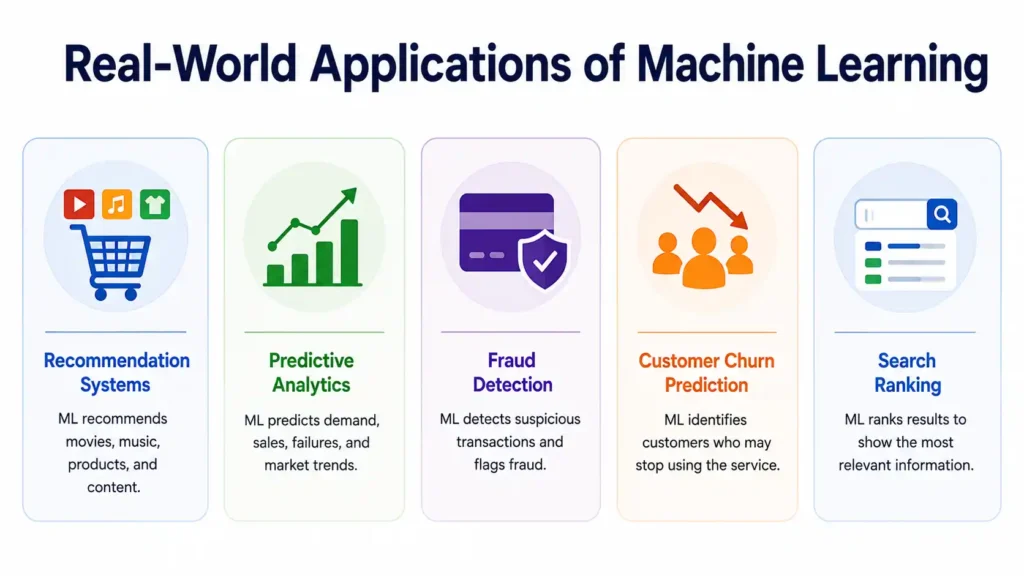
Recommendation Systems
Streaming platforms and online stores use machine learning to recommend movies, music, products, and content.
Predictive Analytics
Organizations use ML to estimate customer demand, sales performance, equipment failure, or market behavior.
Fraud Detection
Machine-learning systems can compare transactions with historical behavior and flag unusual activity.
Customer Churn Prediction
A business can use ML to identify customers who may stop using its service.
Search Ranking
Search and information-retrieval systems use machine-learning signals to determine which results are most relevant to a user’s query.
Real-World Applications of Deep Learning
Deep learning is commonly used for problems involving complex patterns and unstructured information.
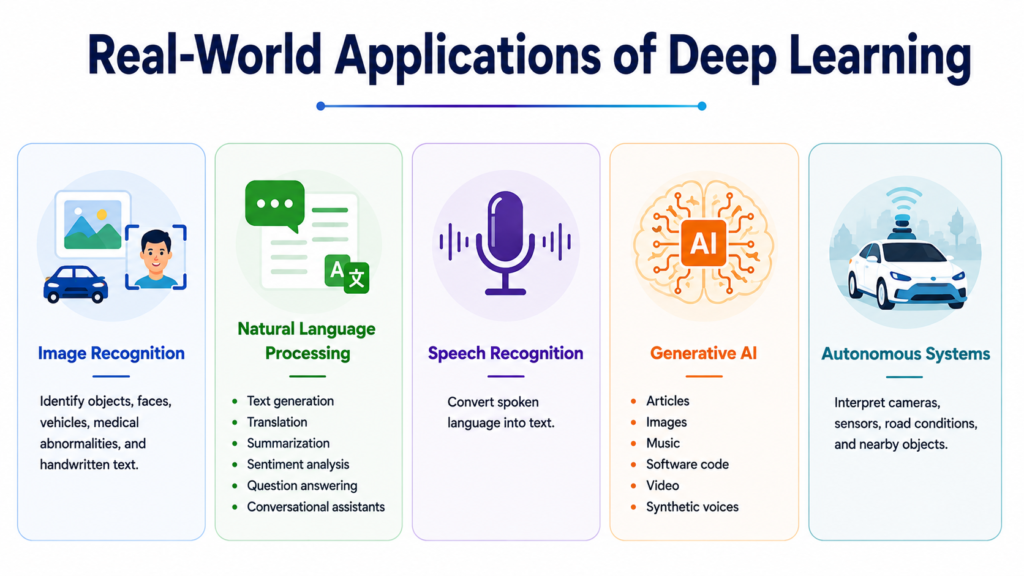
Image Recognition
Deep neural networks can identify objects, faces, vehicles, medical abnormalities, and handwritten text.
Natural Language Processing
Deep learning powers many systems used for:
- Text generation
- Translation
- Summarization
- Sentiment analysis
- Question answering
- Conversational assistants
Speech Recognition
Voice assistants and transcription tools use deep-learning models to convert spoken language into text.
Generative AI
Many generative AI tools use deep-learning architectures to create:
- Articles
- Images
- Music
- Software code
- Video
- Synthetic voices
Autonomous Systems
Deep learning can help autonomous systems interpret cameras, sensors, road conditions, and nearby objects.
Advantages of Artificial Intelligence
AI can provide several important benefits:
- Automates repetitive work
- Processes large amounts of information
- Supports faster decision-making
- Improves service availability
- Identifies patterns humans may overlook
- Helps personalize user experiences
- Reduces some operational costs
- Supports innovation in products and services
However, AI results depend on system design, data quality, testing, monitoring, and responsible use.
Advantages of Machine Learning
Machine learning is valuable because it can:
- Learn from historical data
- Improve as additional data becomes available
- Find complex patterns
- Make predictions at scale
- Personalize recommendations
- Automate classification tasks
- Adapt to changing behavior
ML is often a practical choice when a project has clear data, measurable outcomes, and a specific prediction problem.
Advantages of Deep Learning
Deep learning offers several strengths:
- Strong performance with images, audio, text, and video
- Automatic feature learning
- Ability to model highly complex relationships
- High scalability with large datasets
- Strong performance in language and vision tasks
- Support for modern generative AI applications
Its advantages are most noticeable when organizations have enough data, computing capacity, and technical expertise.
Limitations of AI, Machine Learning, and Deep Learning
These technologies also have important limitations.
Data Quality Problems
A model trained on incomplete, inaccurate, or biased data may produce poor results.
Bias
AI systems may reproduce or amplify patterns of unfairness present in their training data or design.
Privacy Concerns
Applications that process personal, financial, medical, or behavioral data require strong privacy and security controls.
High Development Costs
Advanced systems may require skilled employees, specialized infrastructure, cloud services, and continuous monitoring.
Lack of Transparency
Some models, especially deep neural networks, can be difficult to interpret.
Hallucinations and Incorrect Outputs
Generative AI systems may produce confident answers that are inaccurate, incomplete, or unsupported.
Ongoing Maintenance
AI models are not always “train once and forget” solutions. They may need updated data, performance monitoring, retraining, and security reviews.
AI vs Machine Learning vs Deep Learning: Which One Should You Learn First?
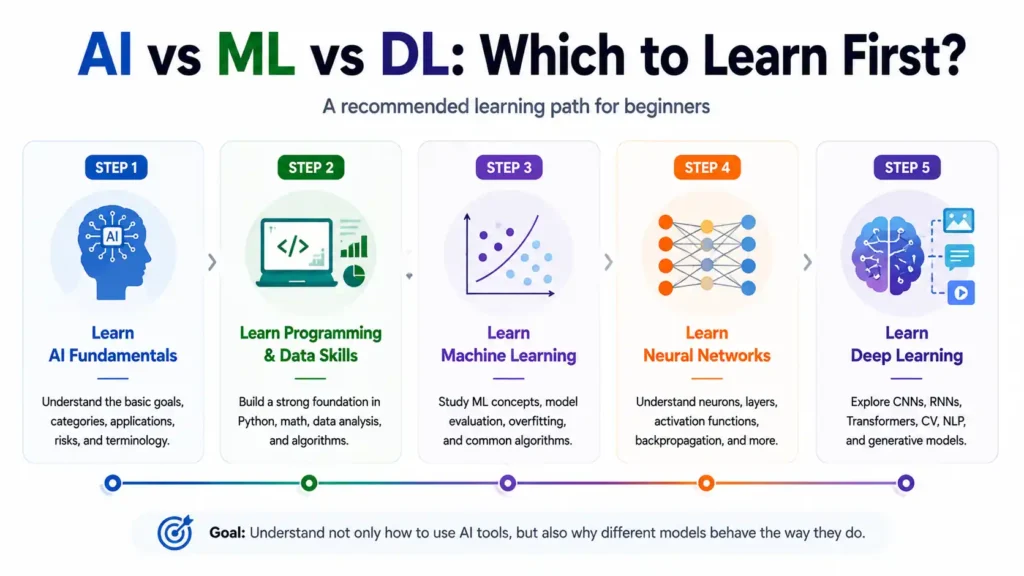
Beginners should usually learn the concepts in the following order:
Step 1: Learn AI Fundamentals
Start with the basic goals, categories, applications, risks, and terminology of artificial intelligence.
Step 2: Learn Programming and Data Skills
Python is widely used in AI development. It is also useful to study:
- Statistics
- Probability
- Linear algebra
- Data preparation
- Data visualization
- Algorithms
Step 3: Learn Machine Learning
Study supervised learning, unsupervised learning, model evaluation, overfitting, feature engineering, and common algorithms.
Step 4: Learn Neural Networks
Understand neurons, layers, activation functions, loss functions, backpropagation, and optimization.
Step 5: Learn Deep Learning
After building a strong ML foundation, explore:
- Convolutional neural networks
- Recurrent neural networks
- Transformers
- Computer vision
- Natural language processing
- Generative models
This progression makes it easier to understand not only how to use AI tools, but also why different models behave the way they do.
FAQs
Q1. What is the main difference between AI and machine learning?
Artificial intelligence is the broad field of creating intelligent computer systems. Machine learning is a subset of AI that allows systems to learn patterns from data instead of depending entirely on manually written rules.
Q2. What is the difference between machine learning and deep learning?
Machine learning includes many algorithms, such as decision trees, regression, and support vector machines. Deep learning is a specialized form of machine learning that uses neural networks with multiple layers.
Q3. Is deep learning better than machine learning?
Deep learning is not always better. It can perform exceptionally well with large amounts of complex data, but traditional machine learning may be faster, easier to explain, and more effective for smaller structured datasets.
Q4. Is ChatGPT AI, machine learning, or deep learning?
ChatGPT is an artificial intelligence application powered by machine learning and deep-learning techniques. It uses a large neural-network architecture trained to process and generate language.
Q5. Does AI always require large amounts of data?
No. Rule-based AI systems can operate without large training datasets. Machine-learning and deep-learning applications generally depend more heavily on data, especially when the problem is complex.
Q6. Which is easier to learn: AI, machine learning, or deep learning?
AI fundamentals are the easiest starting point because they introduce the overall field. Machine learning requires programming, data, and mathematical knowledge. Deep learning normally requires a stronger understanding of machine learning and neural networks.
Q7. Can machine learning work without deep learning?
Yes. Many useful machine-learning systems use regression, decision trees, random forests, clustering, and other algorithms without deep neural networks.
Q8. Can artificial intelligence work without machine learning?
Yes. Rule-based systems, expert systems, search algorithms, and manually programmed decision logic can provide AI capabilities without learning from data.