
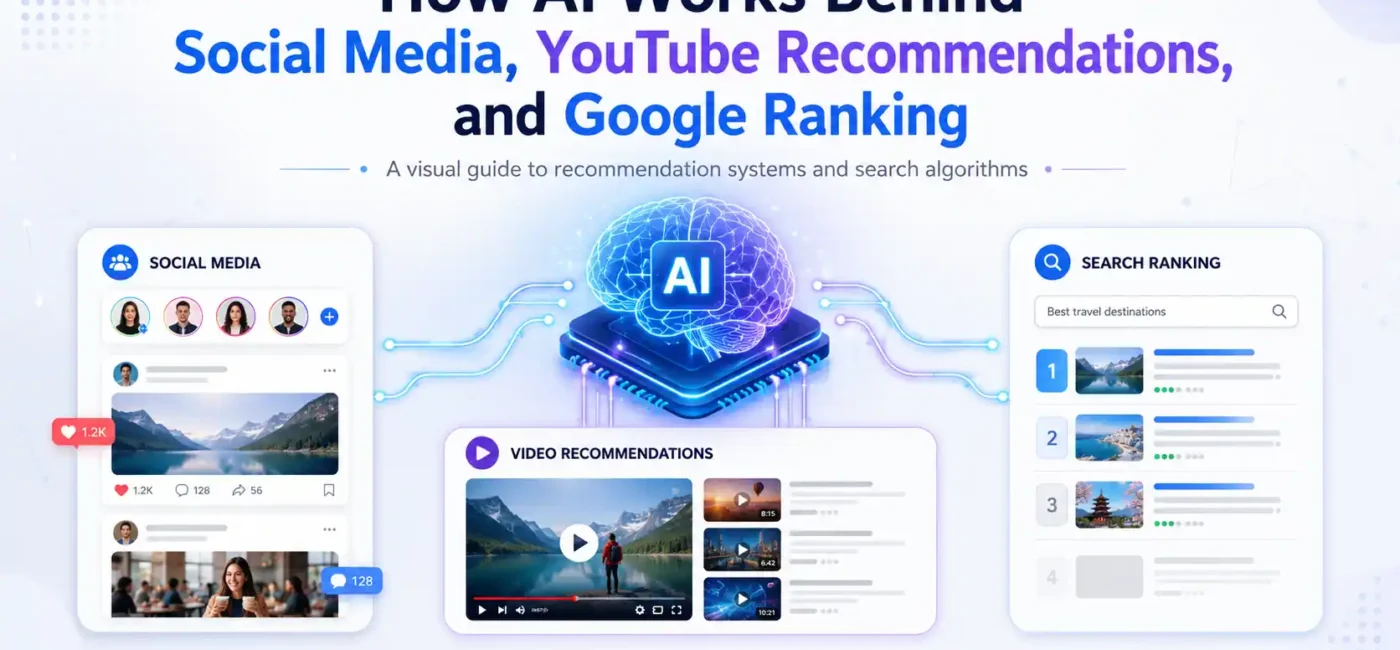
Artificial Intelligence (AI) is no longer just a modern technology trend; it has become the core ranking engine behind social media platforms, YouTube recommendation systems, and Google search algorithms. Every action you take online—whether scrolling Instagram, watching a YouTube video, or searching on Google—is continuously analyzed by AI systems in real time. These intelligent systems are built to understand human behavior, predict future actions, and deliver highly personalized content designed to maximize engagement and user satisfaction.
In today’s digital ecosystem, AI-driven recommendation systems influence nearly 90% of online content discovery, making them extremely important for content creators, digital marketers, SEO experts, and businesses. Platforms such as Google, YouTube, Facebook, Instagram, and TikTok rely on advanced machine learning models, deep neural networks, and natural language processing (NLP) to rank and recommend content based on user behavior patterns.
Modern AI ranking systems are designed to continuously learn and evolve through massive datasets generated by billions of users every day. These systems analyze engagement behavior such as click patterns, watch duration, scroll depth, and interaction frequency to determine content quality and relevance. Over time, AI builds highly accurate predictive models that help platforms understand what type of content will keep users active for longer periods. This is why personalized feeds on social media and search results on Google feel so accurate and user-specific.
Another important aspect of AI in digital ranking is real-time optimization. Instead of relying on static rules, AI systems constantly adjust rankings based on live user feedback. If a piece of content performs well in a short period of time, it is quickly boosted to a wider audience. On the other hand, low-performing content is gradually reduced in visibility. This dynamic system ensures that only the most engaging and relevant content reaches the top positions across platforms.
This complete SEO guide explains how AI works behind these platforms, how ranking systems operate, which signals are used for content ranking, and which AI tools can help improve visibility, engagement, and overall SEO performance in 2026.
How Artificial Intelligence Powers Social Media Algorithms
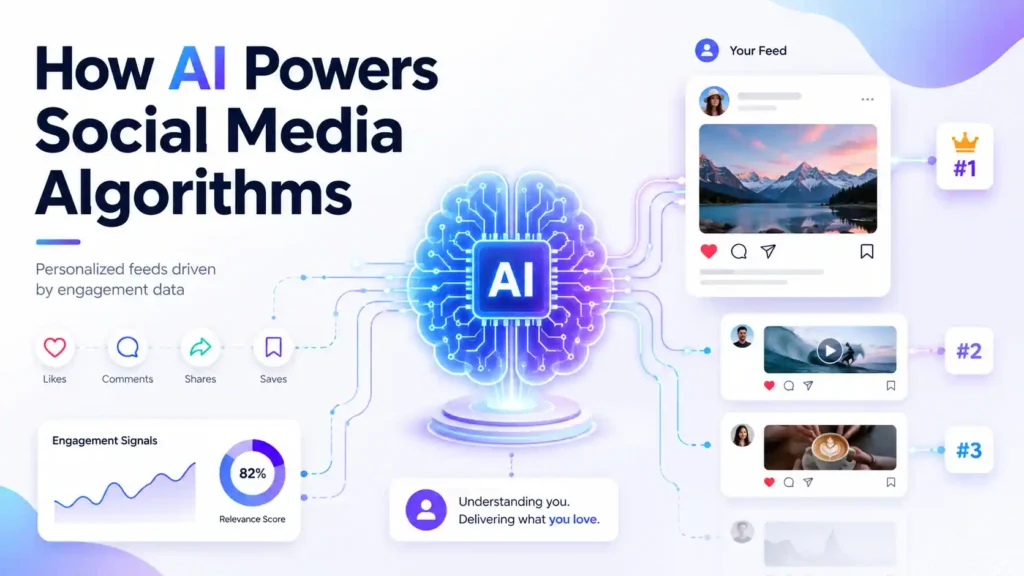
Social media platforms are fully powered by machine learning-based AI algorithms that continuously analyze user activity to create highly personalized content feeds. Instead of showing the same content to everyone, AI builds a digital behavior profile for each user based on interaction history and engagement patterns.
Every interaction becomes valuable training data for AI systems, including:
- Likes, reactions, and shares
- Comments and replies
- Video watch time and completion rate
- Scroll speed and pause behavior
- Profile visits and content saves
These data points are processed using deep learning models and reinforcement learning algorithms, which constantly refine recommendations to improve accuracy.
For example, if a user consistently watches fitness-related content, AI automatically increases the visibility of fitness videos, pages, and posts. This is called engagement-based ranking, which plays a major role in modern social media SEO optimization.
Social platforms also use a test-and-scale model, where new content is first shown to a small audience. If engagement metrics like likes, shares, and watch time are strong, the AI system promotes the content to a wider audience. This is how viral content spreads across platforms within hours.
Timing, engagement quality, and content relevance all play a critical role in determining whether content gets high visibility or disappears quickly from feeds.
How the YouTube Recommendation System Works (AI Deep Learning Model)
YouTube is one of the most advanced AI-powered platforms in the world, and its recommendation engine is driven by Google’s deep learning infrastructure. The system analyzes billions of video interactions every day to decide which videos should be recommended to users.
The YouTube AI algorithm mainly depends on three core ranking signals:
1. Click-Through Rate (CTR) Optimization
CTR measures how many users click on a video after seeing its thumbnail and title. A higher CTR indicates strong SEO optimization, attractive thumbnails, and effective keyword targeting.
2. Watch Time and Audience Retention
Watch time is one of the most powerful ranking factors in YouTube SEO. AI tracks how long users stay engaged with a video. Higher retention signals mean better content quality and higher ranking potential.
3. User Satisfaction Signals
YouTube also analyzes engagement signals such as:
- Likes and dislikes ratio
- Comments and interaction quality
- Shares and playlist saves
- “Not interested” feedback
In addition, YouTube uses session-based AI modeling, which measures how long users stay on the platform after watching a video. If your video increases total session time, the algorithm promotes it further in recommendations.
The recommendation system operates across:
- Home feed recommendations
- “Up Next” video suggestions
- Search results ranking
This is why different users searching the same keyword often see completely different videos—AI personalizes results based on user behavior and preferences.
Google Search Ranking Algorithm and AI SEO System
Google Search is powered by a combination of AI ranking models, semantic search systems, and natural language processing (NLP). Instead of simply matching keywords, Google AI understands the intent and meaning behind every search query.
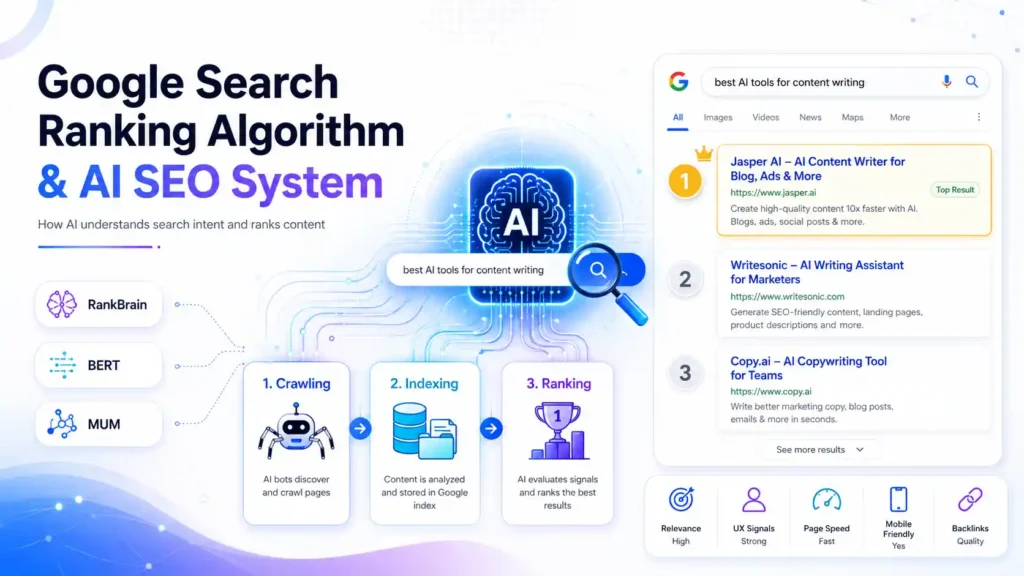
Google ranking operates in three main stages:
1. Crawling
Google bots scan websites and collect content from billions of web pages across the internet.
2. Indexing
Collected data is stored in Google’s massive database, where AI organizes and categorizes content based on topics and relevance.
3. Ranking (AI Decision System)
Machine learning models decide which page should appear at the top of search results.
Google uses advanced AI systems such as:
- RankBrain – Learns user intent patterns
- BERT – Understands language context and meaning
- MUM – Multitask AI system for complex queries
These systems analyze multiple ranking factors, including:
- Content relevance and topic depth
- Keyword context and semantic meaning
- User experience (UX) signals
- Page speed and mobile responsiveness
- Backlinks and domain authority
Modern SEO is no longer about keyword stuffing. Instead, it focuses on high-quality content, user satisfaction, and semantic relevance.
For example, when a user searches “best AI tools for content writing,” Google AI understands that the intent is to find comparisons, tools, and recommendations—not just definitions.
Key AI Ranking Signals Used Across Platforms
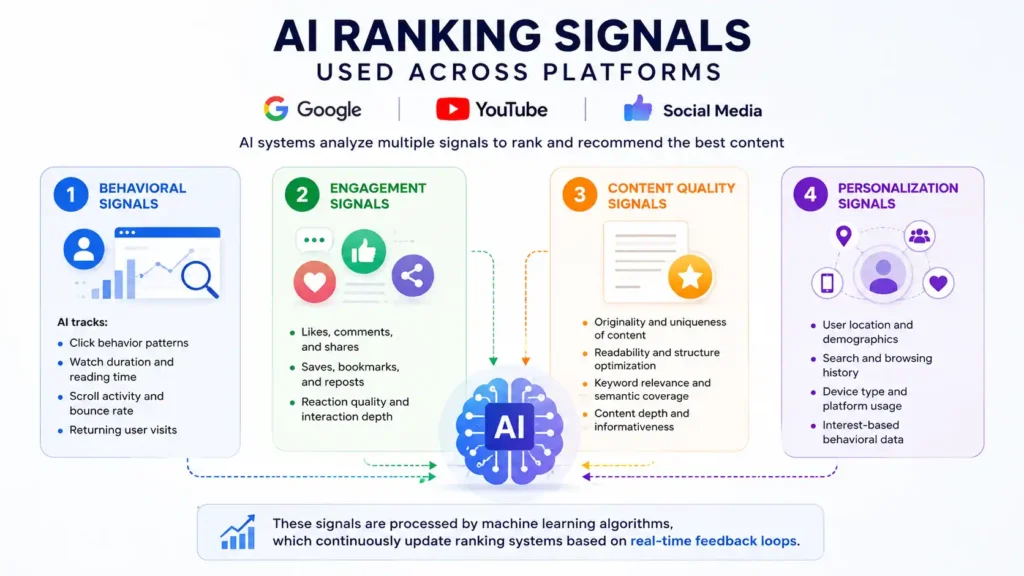
AI systems across Google, YouTube, and social media platforms rely on shared ranking signals to evaluate content performance and decide visibility.
1. Behavioral Signals
AI tracks:
- Click behavior patterns
- Watch duration and reading time
- Scroll activity and bounce rate
- Returning user visits
2. Engagement Signals
- Likes, comments, and shares
- Saves, bookmarks, and reposts
- Reaction quality and interaction depth
3. Content Quality Signals
- Originality and uniqueness of content
- Readability and structure optimization
- Keyword relevance and semantic coverage
- Content depth and informativeness
4. Personalization Signals
- User location and demographics
- Search and browsing history
- Device type and platform usage
- Interest-based behavioral data
These signals are processed by machine learning algorithms, which continuously update ranking systems based on real-time feedback loops.
AI Tools That Improve SEO, Social Media Growth, and YouTube Ranking
Modern digital creators rely heavily on AI tools to optimize content for better performance across search engines and social platforms. These tools help in keyword research, content creation, video optimization, and SEO analytics.
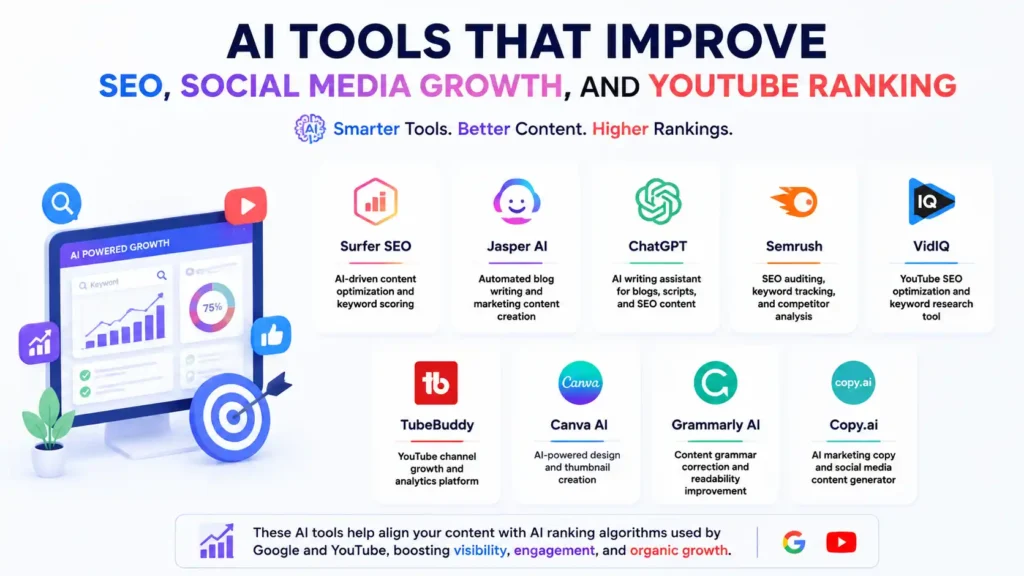
Top AI SEO & Content Optimization Tools:
- Surfer SEO – AI-driven content optimization and keyword scoring
- Jasper AI – Automated blog writing and marketing content creation
- ChatGPT – AI writing assistant for blogs, scripts, and SEO content
- Semrush – SEO auditing, keyword tracking, and competitor analysis
- VidIQ – YouTube SEO optimization and keyword research tool
- TubeBuddy – YouTube channel growth and analytics platform
- Canva AI – AI-powered design and thumbnail creation
- Grammarly AI – Content grammar correction and readability improvement
- Copy.ai – AI marketing copy and social media content generator
These tools help align content with AI ranking algorithms used by Google and YouTube, significantly improving visibility, engagement, and organic traffic growth.
Future of AI in Content Ranking and Digital Platforms
The future of AI in digital platforms is rapidly evolving toward predictive personalization, automation, and real-time content generation. Instead of waiting for users to search, AI will actively recommend content based on predicted behavior patterns.
Upcoming AI-driven trends include:
- Hyper-personalized search results
- AI-generated video and content recommendations
- Voice-based AI search systems
- Real-time ranking updates
- Emotion and sentiment-based content analysis
Google and YouTube are already testing systems that understand user intent at a psychological and behavioral level, making content discovery more accurate, predictive, and intelligent.
Industry research predicts that by 2027, over 95% of digital content consumption will be influenced by AI recommendation systems, making SEO optimization and AI-driven content strategy more important than ever before.
FAQs
1. How does AI affect Google search ranking and SEO performance?
AI affects Google search ranking by using machine learning models like RankBrain, BERT, and MUM to analyze search intent, content relevance, backlinks, and user experience signals.
2. What are the most important Google ranking factors in 2026?
The most important Google ranking factors include content quality, keyword optimization, page speed, mobile responsiveness, user engagement, domain authority, and backlink profile. AI also considers behavioral signals like click-through rate (CTR), bounce rate, and dwell time to decide SEO ranking positions in search results.
3. How does YouTube AI algorithm decide video ranking and recommendations?
YouTube AI algorithm ranks videos based on watch time, audience retention, CTR (Click-Through Rate), engagement rate, and user satisfaction signals. Videos with higher retention and engagement are pushed into YouTube recommendations, home feed, and suggested video sections, improving overall SEO visibility on the platform.
4. Why is my website not ranking on Google search engine despite SEO optimization?
A website may not rank due to weak content relevance, low-quality backlinks, poor user engagement, slow page speed, or incorrect keyword targeting. Google AI evaluates overall SEO performance, including content depth, semantic relevance, and user experience signals, before ranking a website in search results.
5. How does social media AI algorithm increase viral content reach?
Social media AI algorithms increase viral reach by analyzing early engagement signals such as likes, shares, comments, saves, and watch time. Content that performs well in the initial testing phase is promoted to a larger audience, boosting visibility on platforms like Instagram, TikTok, and Facebook.
6. What is the role of machine learning in SEO and content ranking?
Machine learning improves SEO by analyzing user behavior patterns, search intent, and content performance metrics. It helps search engines understand semantic meaning, keyword relevance, and content quality, enabling more accurate ranking decisions in Google search results.
7. Which AI tools are best for SEO optimization and content ranking improvement?
The best AI SEO tools include Semrush, Ahrefs, Surfer SEO, ChatGPT, Jasper AI, VidIQ, TubeBuddy, Grammarly AI, and Copy.ai. These tools help with keyword research, content writing, backlink analysis, YouTube SEO, and website optimization for higher Google ranking.
8. How does Google AI understand search queries and user intent?
Google AI uses advanced natural language processing (NLP) models like BERT and MUM to understand search intent, contextual meaning, and semantic relationships between words. This helps Google deliver highly relevant SEO results based on what users actually want, not just keywords.
9. Can AI help improve website SEO ranking and organic traffic?
Yes, AI helps improve SEO ranking by optimizing content structure, keyword targeting, readability score, internal linking, and engagement signals. AI-powered SEO tools also provide insights that improve Google search visibility, organic traffic growth, and ranking performance.
10. What is the future of AI in Google search and SEO optimization?
The future of AI in SEO includes predictive search, real-time ranking updates, voice-based search optimization, and AI-generated search results. Google is moving toward a fully AI-driven system where user intent prediction and personalized search results will dominate SEO ranking strategies.