
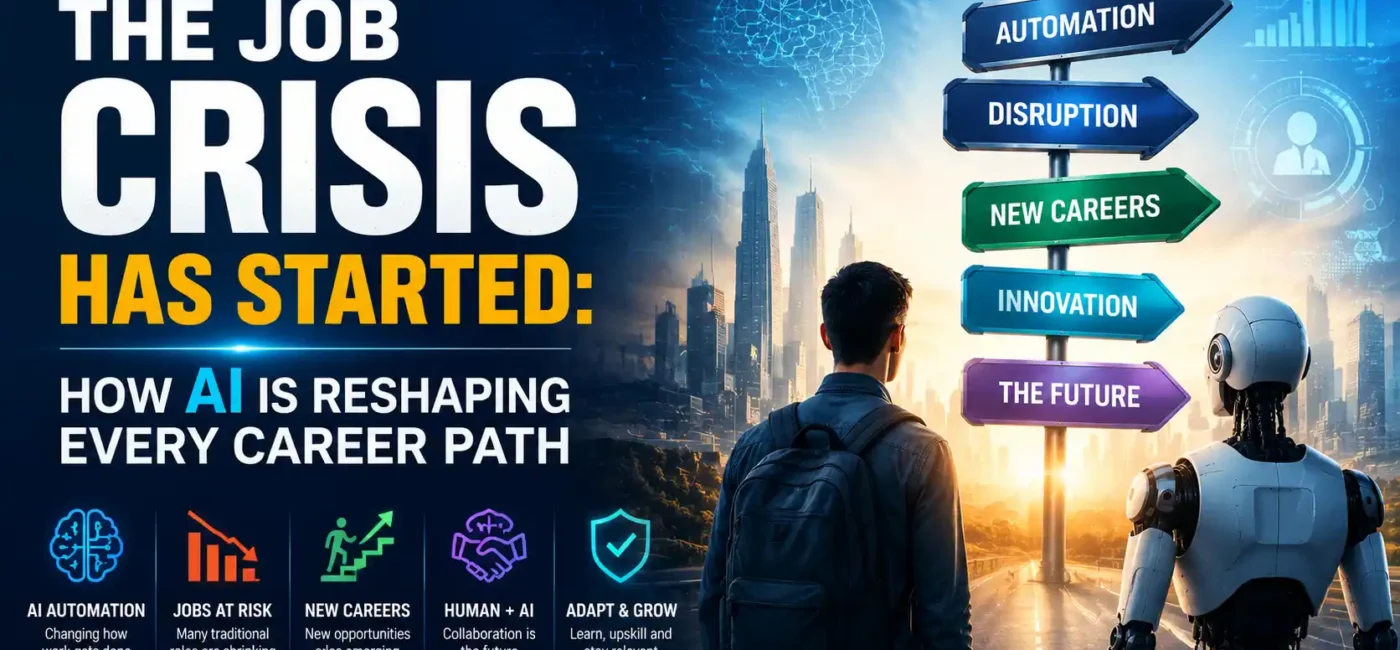
The answer is not simple. But one thing is clear: every career path is being reshaped. The job crisis is not just about people losing employment — it is about the rapid transformation of skills, roles, and entire industries. This ongoing job crisis is forcing workers to adapt faster than ever before, as traditional job structures are being broken into smaller, automated tasks and rebuilt through AI systems. Career stability is no longer guaranteed, and continuous learning has become a requirement for survival in the modern workforce.
What makes this job crisis more complex is its silent nature. It is not happening through sudden layoffs alone, but through the gradual replacement of tasks by automation and AI tools. Many roles are not disappearing instantly; instead, they are shrinking in scope, reducing the need for large teams. Entry-level opportunities are becoming harder to find, while productivity expectations are increasing significantly. At the same time, companies are demanding hybrid skills where one individual can manage multiple responsibilities using AI assistance.
As a result, professionals are no longer competing only with other humans — they are also competing with AI-augmented workflows. This shift is redefining what it means to be employable in the modern world.
The Nature of Work Is Changing, Not Just Jobs
Most people think AI is replacing jobs. But the deeper reality is more complex.
AI is not just removing roles — it is breaking jobs into tasks and rebuilding them in new ways.
A single profession today is a bundle of micro-tasks:
- Writing emails
- Researching information
- Creating visuals
- Analyzing data
- Communicating insights
AI is now capable of handling many of these tasks individually. This means:
- One employee can now do the work of many
- Teams are becoming smaller
- Productivity expectations are rising
- Entry-level roles are shrinking
Instead of replacing entire careers at once, AI is quietly reshaping how every job is structured.
The First Wave: Jobs Already Being Affected
Some industries are feeling the impact earlier than others. These include:
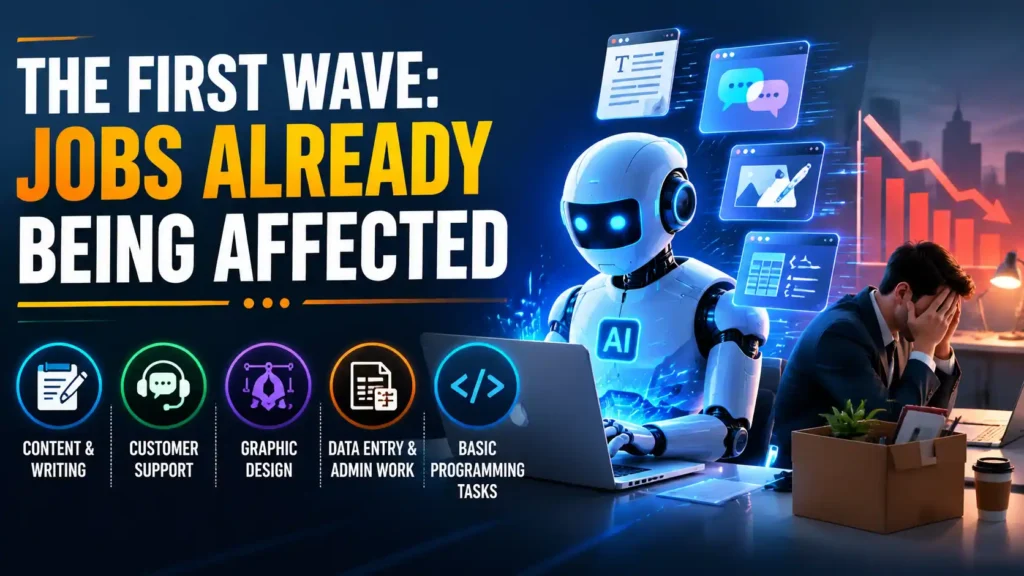
Content and Writing
AI tools like ChatGPT, Jasper AI, and Copy.ai can generate articles, ads, scripts, and social posts in seconds. While human creativity is still valuable, routine writing tasks are increasingly automated. This is especially visible in marketing departments, blogging platforms, and media agencies where speed and volume matter more than deep originality. As a result, many junior writing roles are being reduced, while demand is shifting toward editors, strategists, and content planners who can refine and guide AI-generated output.
Customer Support
Chatbots and AI assistants like Zendesk AI now handle large portions of customer queries. Human agents are often needed only for complex issues that require emotional intelligence or decision-making. This has significantly reduced the need for large support teams, especially in e-commerce and SaaS companies. At the same time, support roles are evolving into supervision and escalation management rather than simple query handling.
Graphic Design
Tools like Adobe Firefly can now generate logos, banners, and social media visuals instantly. Designers are shifting from creation to direction and refinement. Instead of spending hours on basic layouts, designers are now expected to focus on branding concepts, creative strategy, and polishing AI-generated designs to meet professional standards. This shift is also increasing demand for visual storytelling, art direction, and brand consistency across multiple platforms, where human judgment is still essential for emotional impact and originality.
Data Entry and Admin Work
These roles are rapidly shrinking as automation handles repetitive digital tasks. Tasks like form filling, record management, and scheduling are now managed by intelligent systems with higher speed and fewer errors, making traditional manual input roles less relevant.
Basic Programming Tasks
AI coding assistants are writing boilerplate code, debugging, and even suggesting architecture improvements. This is reducing the time required for routine development work and pushing developers toward higher-level system design, logic building, and complex problem-solving rather than repetitive coding tasks.
Overall, this first wave does not eliminate jobs completely — but it significantly reduces the need for repetitive, structured, and predictable work across industries, reshaping how organizations define roles and productivity.
The Rise of “AI-Augmented Workers”
Instead of full replacement, the most common trend is augmentation.
An AI-augmented worker is someone who:
- Uses AI tools to increase output
- Delegates repetitive tasks to machines
- Focuses on decision-making and creativity
- Works faster and more efficiently than before
For example:
- A marketer uses AI to generate ad variations
- A lawyer uses AI to summarize case law
- A teacher uses AI to design lesson plans
- A developer uses AI to speed up coding
In this new environment, the question is no longer:
“Can AI do my job?”
But rather:
“Can I work better than someone who uses AI?”
Entry-Level Jobs Are Disappearing First
One of the most concerning trends is the impact on entry-level roles.
Traditionally, young professionals started careers by doing:
- Research
- Data collection
- Basic writing
- Junior analysis
- Administrative tasks
These were stepping stones to higher roles.
But AI is now capable of doing many of these tasks instantly and cheaply.
This creates a gap:
- Fewer entry-level positions
- Higher expectations for new graduates
- Difficulty gaining real-world experience
This is one of the earliest signs of a structural job crisis.
The Winners: Skills That AI Cannot Easily Replace
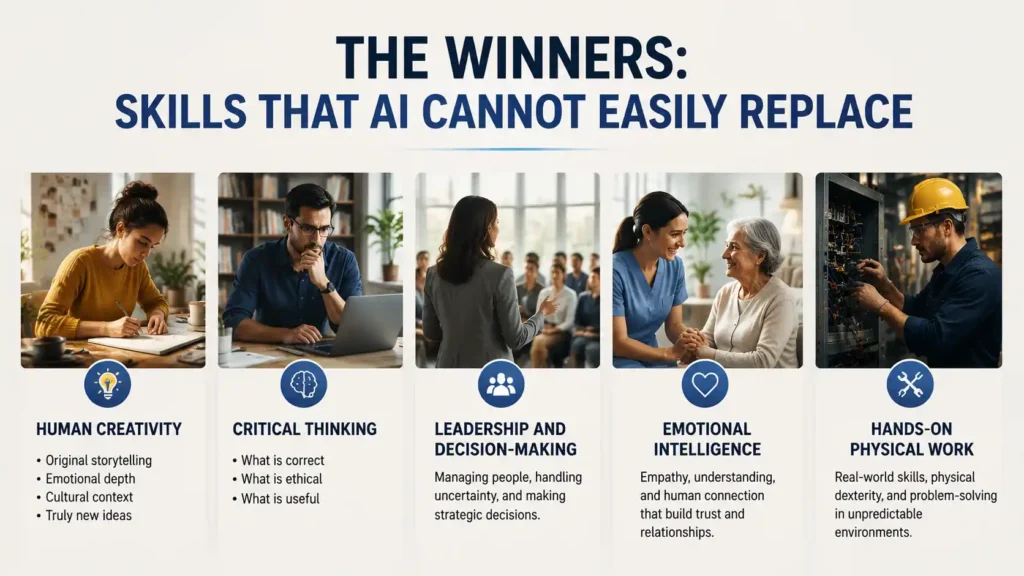
Human Creativity
AI can generate content, but it still struggles with:
- Original storytelling
- Emotional depth
- Cultural context
- Truly new ideas
While AI is extremely powerful at remixing existing patterns, it still lacks lived experience and genuine human intuition. Creativity is not just about producing output — it is about connecting emotions, memories, and perspectives in a way that feels meaningful. Human creators bring personal experiences, cultural understanding, and emotional sensitivity that cannot be fully replicated by algorithms. This is why creative roles are evolving rather than disappearing, with humans focusing more on ideation, direction, and storytelling vision while AI handles execution support.
Critical Thinking
AI provides answers, but humans must still decide:
- What is correct
- What is ethical
- What is useful
In real-world applications, AI outputs can be misleading or incomplete. Humans are needed to question assumptions, verify accuracy, and interpret results in context. Critical thinking becomes even more important as information becomes easier to generate but harder to validate. The ability to analyze multiple perspectives and make balanced judgments remains a deeply human strength.
Leadership and Decision-Making
Managing people, handling uncertainty, and making strategic decisions remain human strengths. Leadership requires emotional understanding, long-term vision, and the ability to navigate unpredictable situations where data alone is not enough. AI can support decision-making, but final accountability and responsibility still rest with humans.
Emotional Intelligence
Jobs requiring empathy — such as healthcare, therapy, teaching, and counseling — remain difficult to automate fully. These roles depend on trust, emotional connection, and human understanding. While AI can assist with diagnostics or information, it cannot replace genuine human care and emotional presence.
Hands-On Physical Work
Electricians, plumbers, technicians, and field engineers are still largely AI-resistant. These roles require real-world interaction with unpredictable environments, physical dexterity, and situational problem-solving that machines cannot easily replicate. As automation grows in digital spaces, skilled manual labor continues to hold strong real-world value.
Overall, these skill areas represent the foundation of human advantage in an AI-driven world, where technology enhances productivity but does not fully replace human judgment and presence.
The New Job Market: Smaller Teams, Bigger Output
Companies are restructuring in a major way.
Instead of hiring large teams, businesses now prefer:
- Small teams powered by AI tools
- Freelancers supported by automation
- Hybrid roles combining multiple skills
A single person can now:
- Write content
- Design visuals
- Run ads
- Analyze performance
- Automate workflows
This leads to a new reality:
Fewer employees, higher productivity per person.
Why This Feels Like a Job Crisis
The term “job crisis” is used because of three psychological and economic pressures:
Speed of Change
Technology is evolving faster than education systems can adapt. New tools, frameworks, and AI systems are emerging every few months, while academic curricula often take years to update, creating a widening gap between real-world industry demands and what students are actually taught in classrooms today across many fields globally.
Skill Mismatch
Many workers are trained for roles that are becoming outdated. As industries shift toward automation and AI-driven systems, existing skill sets no longer fully match job requirements. This creates a gap between available talent and market demand, forcing professionals to continuously reskill and adapt quickly to remain employable in changing environments.
Uncertainty
People are unsure which careers will remain stable in the next 10 years. Rapid AI adoption, automation, and shifting industry needs make long-term career planning difficult. This uncertainty leads to hesitation in choosing paths, increased career switching, and a growing need for continuous learning to stay relevant in an unpredictable job market.
Even if total employment does not collapse, the transition period feels unstable — and that instability creates fear.
Another major factor is the visibility of automation. Unlike past changes, AI impact is happening in real time, so people can clearly see tools replacing tasks they once did manually. Social media also amplifies this fear by constantly showing layoffs, AI breakthroughs, and “future of work” predictions.
At the same time, companies are quietly restructuring teams, preferring smaller, AI-powered workflows instead of large departments. This creates pressure on workers to constantly upgrade skills just to remain relevant. Together, these factors make the shift feel less like gradual progress and more like a sudden job crisis, even when the change is still unfolding.
Education Systems Are Not Ready
One of the biggest challenges is that schools and universities are still teaching outdated models.
Students learn:
- Memorization-based knowledge
- Static skill sets
- The idea of one fixed career path
But the modern AI-driven world demands:
- Continuous learning
- Adaptability
- Tool-based skills
- Cross-disciplinary thinking
This gap between education and industry is widening every year.
The Rise of New Careers
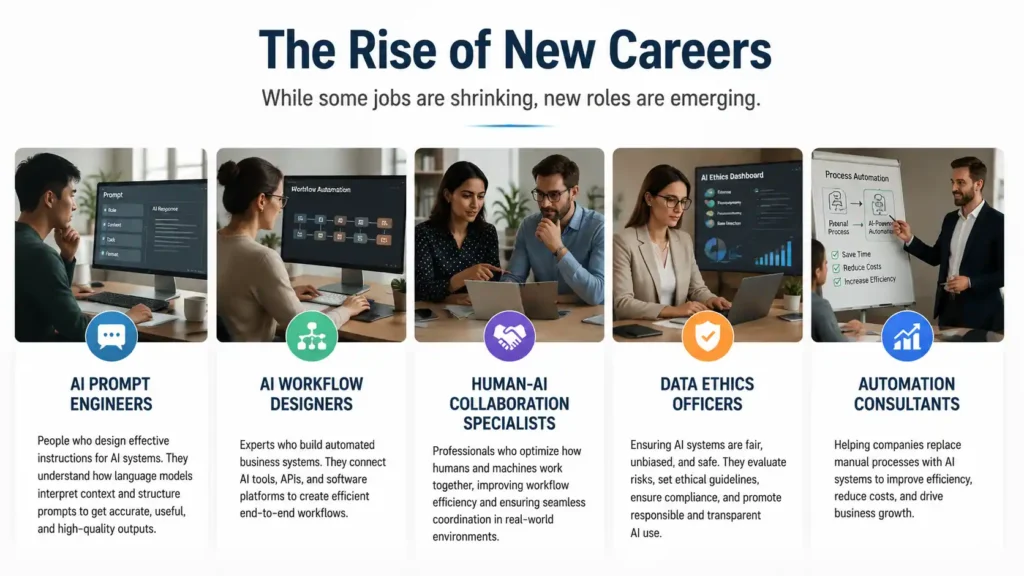
While some jobs are shrinking, new roles are emerging:
AI Prompt Engineers
People who design effective instructions for AI systems. They understand how language models interpret context and structure prompts to get accurate, useful, and high-quality outputs. This role requires strong communication skills, logical thinking, and experimentation to optimize AI responses for different tasks, industries, and real-world applications.
AI Workflow Designers
Experts who build automated business systems. They connect AI tools, APIs, and software platforms to create efficient end-to-end workflows. Their goal is to reduce manual effort, improve productivity, and streamline operations by designing systems where tasks are automatically executed, monitored, and optimized using AI-driven processes.
Human-AI Collaboration Specialists
Professionals who optimize how humans and machines work together. They design interaction models where AI handles repetitive or data-heavy tasks, while humans focus on judgment, creativity, and decision-making. Their role includes improving workflow efficiency, reducing errors, and ensuring seamless coordination between AI systems and human input in real-world environments, while maintaining productivity and trust.
Data Ethics Officers
Ensuring AI systems are fair, unbiased, and safe. They evaluate datasets, model outputs, and decision-making processes to identify potential discrimination or harmful bias. Their role also includes setting ethical guidelines, ensuring regulatory compliance, and maintaining transparency in AI systems so that technology is used responsibly and does not negatively impact individuals or society.
Automation Consultants
Helping companies replace manual processes with AI systems. They analyze business operations, identify repetitive tasks, and design automated solutions using AI tools, APIs, and software integrations. Their goal is to improve efficiency, reduce costs, and streamline workflows while ensuring smooth transition from traditional processes to intelligent, AI-driven systems.
The job market is not just shrinking — it is transforming.